p.4 抽出テキスト
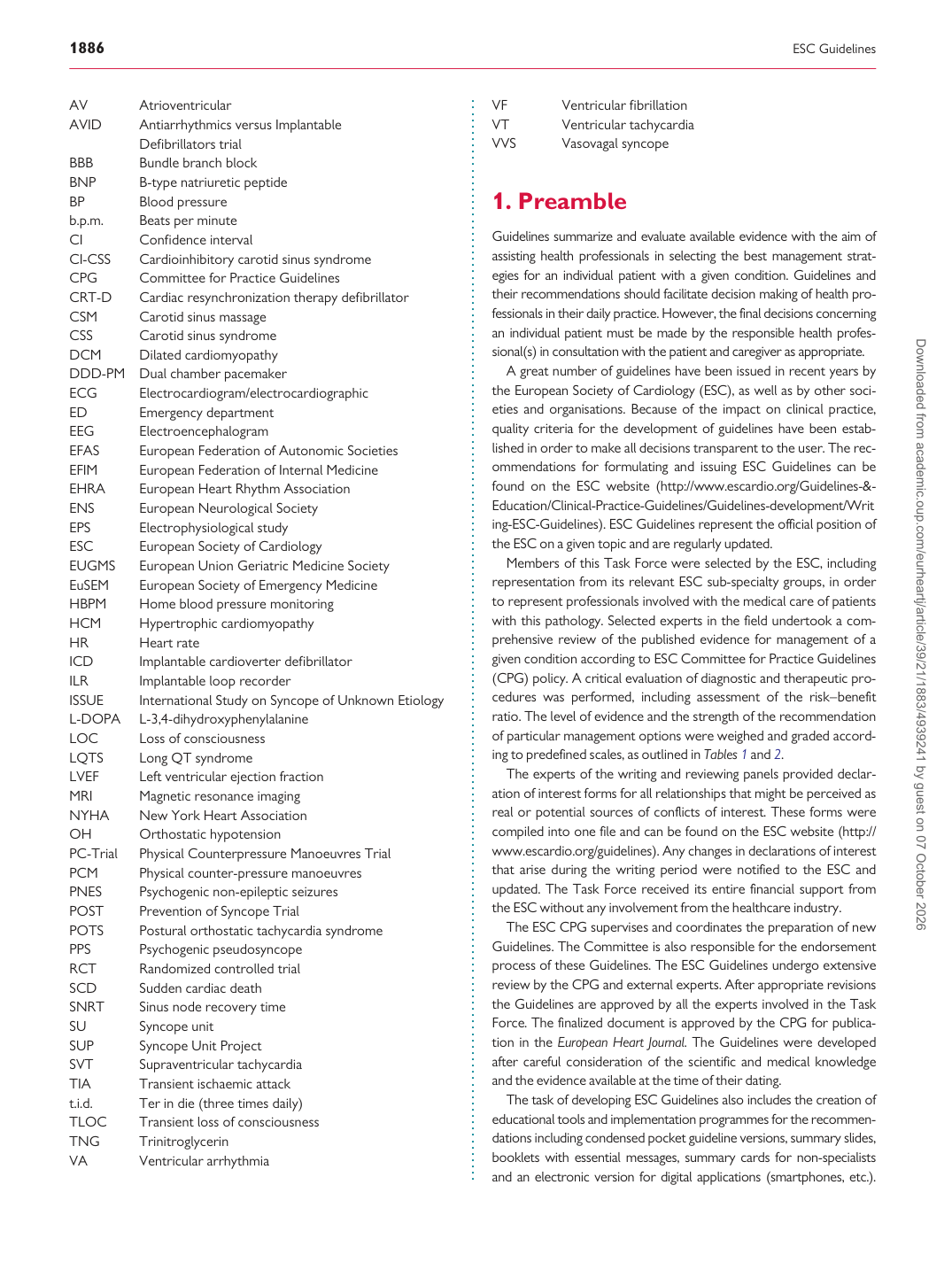
............................................................................................................................................................................ AV Atrioventricular AVID Antiarrhythmics versus Implantable Defibrillators trial BBB Bundle branch block BNP B-type natriuretic peptide BP Blood pressure b.p.m. Beats per minute CI Confidence interval CI-CSS Cardioinhibitory carotid sinus syndrome CPG Committee for Practice Guidelines CRT-D Cardiac resynchronization therapy defibrillator CSM Carotid sinus massage CSS Carotid sinus syndrome DCM Dilated cardiomyopathy DDD-PM Dual chamber pacemaker ECG Electrocardiogram/electrocardiographic ED Emergency department EEG Electroencephalogram EFAS European Federation of Autonomic Societies EFIM European Federation of Internal Medicine EHRA European Heart Rhythm Association ENS European Neurological Society EPS Electrophysiological study ESC European Society of Cardiology EUGMS European Union Geriatric Medicine Society EuSEM European Society of Emergency Medicine HBPM Home blood pressure monitoring HCM Hypertrophic cardiomyopathy HR Heart rate ICD Implantable cardioverter defibrillator ILR Implantable loop recorder ISSUE International Study on Syncope of Unknown Etiology L-DOPA L-3,4-dihydroxyphenylalanine LOC Loss of consciousness LQTS Long QT syndrome LVEF Left ventricular ejection fraction MRI Magnetic resonance imaging NYHA New York Heart Association OH Orthostatic hypotension PC-Trial Physical Counterpressure Manoeuvres Trial PCM Physical counter-pressure manoeuvres PNES Psychogenic non-epileptic seizures POST Prevention of Syncope Trial POTS Postural orthostatic tachycardia syndrome PPS Psychogenic pseudosyncope RCT Randomized controlled trial SCD Sudden cardiac death SNRT Sinus node recovery time SU Syncope unit SUP Syncope Unit Project SVT Supraventricular tachycardia TIA Transient ischaemic attack t.i.d. Ter in die (three times daily) TLOC Transient loss of consciousness TNG Trinitroglycerin VA Ventricular arrhythmia VF Ventricular fibrillation VT Ventricular tachycardia VVS Vasovagal syncope

1 Preamble

Guidelines summarize and evaluate available evidence with the aim of assisting health professionals in selecting the best management strategies for an individual patient with a given condition. Guidelines and their recommendations should facilitate decision making of health professionals in their daily practice. However, the final decisions concerning an individual patient must be made by the responsible health professional(s) in consultation with the patient and caregiver as appropriate. A great number of guidelines have been issued in recent years by the European Society of Cardiology (ESC), as well as by other societies and organisations. Because of the impact on clinical practice, quality criteria for the development of guidelines have been established in order to make all decisions transparent to the user. The recommendations for formulating and issuing ESC Guidelines can be found on the ESC website (http://www.escardio.org/Guidelines-&- Education/Clinical-Practice-Guidelines/Guidelines-development/Writ ing-ESC-Guidelines). ESC Guidelines represent the official position of the ESC on a given topic and are regularly updated. Members of this Task Force were selected by the ESC, including representation from its relevant ESC sub-specialty groups, in order to represent professionals involved with the medical care of patients with this pathology. Selected experts in the field undertook a comprehensive review of the published evidence for management of a given condition according to ESC Committee for Practice Guidelines (CPG) policy. A critical evaluation of diagnostic and therapeutic procedures was performed, including assessment of the risk–benefit ratio. The level of evidence and the strength of the recommendation of particular management options were weighed and graded according to predefined scales, as outlined in Tables 1 and 2. The experts of the writing and reviewing panels provided declaration of interest forms for all relationships that might be perceived as real or potential sources of conflicts of interest. These forms were compiled into one file and can be found on the ESC website (http:// www.escardio.org/guidelines). Any changes in declarations of interest that arise during the writing period were notified to the ESC and updated. The Task Force received its entire financial support from the ESC without any involvement from the healthcare industry. The ESC CPG supervises and coordinates the preparation of new Guidelines. The Committee is also responsible for the endorsement process of these Guidelines. The ESC Guidelines undergo extensive review by the CPG and external experts. After appropriate revisions the Guidelines are approved by all the experts involved in the Task Force. The finalized document is approved by the CPG for publication in the European Heart Journal. The Guidelines were developed after careful consideration of the scientific and medical knowledge and the evidence available at the time of their dating. The task of developing ESC Guidelines also includes the creation of educational tools and implementation programmes for the recommendations including condensed pocket guideline versions, summary slides, booklets with essential messages, summary cards for non-specialists and an electronic version for digital applications (smartphones, etc.). Downloaded from academic.oup.com/eurheartj/article/39/21/1883/4939241 by guest on 07 October 2026