p.39 抽出テキスト
..........................................................................................................................................................................

lost after 8 weeks.333 Thus, current evidence is insufficient to confirm the efficacy of droxidopa for long-term use.

5.4 Cardiac arrhythmias as the primary

cause 5.4.1 Syncope due to intrinsic sinoatrial or atrioventricular conduction system disease Current management strategies in patients with syncope due to intrinsic cardiac bradycardia are summarized in Figure 13. 5.4.1.1 Sinus node disease In general, cardiac pacemaker therapy is indicated and has proved effective in intrinsic sinus node disease when intermittent sinus arrest or sinoatrial block has been demonstrated to account for syncope by means of ECG documentation during spontaneous syncope.334–338

A frequent situation is that of patients who have prolonged sinus pause following the termination of tachycardia in bradycardia-tachycardia syndrome due to the abnormally prolonged time needed for the recovery of automaticity by a diseased sinus node. Permanent pacing does not affect survival.

When the correlation between symptoms and ECG is established, there is general consensus that cardiac pacing is effective and useful for symptom relief. In the absence of the above situations, despite adequate pacing, syncope recurs in approximately 15–28% of patients at 5 years339–341 (see Supplementary Data Table 9). This is due to the frequent association of a vasodepressor reflex mechanism with sinus node disease. In patients with sinus node disease and syncope, carotid sinus hypersensitivity and a positive response to tilt are present in <_50% of patients. Thus, an increased susceptibility to neurally mediated bradycardia/ hypotension is often the cause of syncope.135,136 A reflex mechanism of syncope fits well with the unpredictable natural history of syncope recurrence. Physicians should be aware that effectiveness of therapy is not well documented in such cases. From a practical perspective, cardiac pacing may be a reasonable solution in patients affected by sinus node disease, who have had documentation of an asymptomatic ventricular pause >3 s (with exceptions for young trained persons, during sleep, and medicated patients), when a competitive diagnosis, i.e. hypotension, can be ruled out.294 An abnormal SNRT enhances the probability of efficacy of cardiac pacing (see section 4.2.6.1).210–212

When the correlation between symptoms and ECG is not established, cardiac pacing may be reasonable in patients with intrinsic sinus node disease, syncope, and documentation of asymptomatic pause(s). The elimination of drugs that may exacerbate or unmask an underlying susceptibility to bradycardia is an important element in preventing syncope recurrence. Percutaneous cardiac ablative techniques for the control of atrial tachyarrhythmia have become of increasing importance in selected patients with the bradycardia-tachycardia form of sick sinus syndrome, but are infrequently used for the prevention of syncope.

5.4.1.2 Atrioventricular conduction system disease Cardiac pacing is the treatment of syncope associated with symptomatic AV block (Figure 13). Although formal RCTs of pacing in thirdor second-degree type 2 AV block have not been performed, some observational studies suggest that pacing is highly effective in preventing syncope recurrences when AV block is documented. Langenfeld et al.341 observed a decline in the rate of syncope from 44 to 3.4% over 5-year follow-up in 115 patients paced for AV block; the recurrence rate was 7% in the subgroup with syncope before pacemaker implantation. More recently, Sud et al.200 reported no syncope recurrence, and Aste et al.255 reported a recurrence of 1% at 5 years after pacemaker implantation among 73 patients with documented

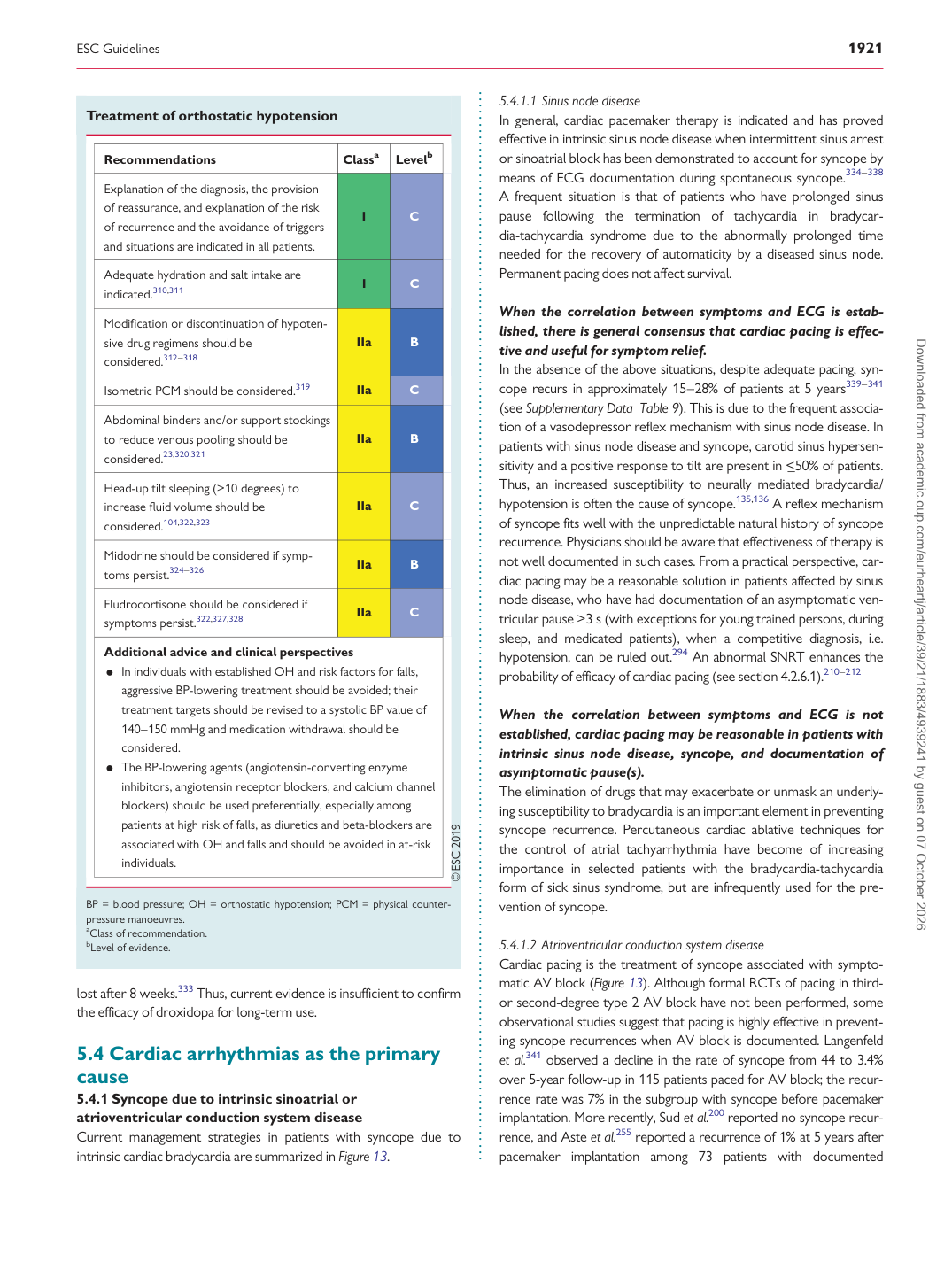
Treatment of orthostatic hypotension

Recommendations Classa Levelb

Explanation of the diagnosis, the provision of reassurance, and explanation of the risk of recurrence and the avoidance of triggers and situations are indicated in all patients. I C

Adequate hydration and salt intake are indicated.310,311 I C

Modification or discontinuation of hypotensive drug regimens should be considered.312–318 IIa B Isometric PCM should be considered.319 IIa C

Abdominal binders and/or support stockings to reduce venous pooling should be considered.23,320,321 IIa B

Head-up tilt sleeping (>10 degrees) to increase fluid volume should be considered.104,322,323 IIa C

Midodrine should be considered if symptoms persist.324–326 IIa B

Fludrocortisone should be considered if symptoms persist.322,327,328 IIa C

Additional advice and clinical perspectives • In individuals with established OH and risk factors for falls,

aggressive BP-lowering treatment should be avoided; their treatment targets should be revised to a systolic BP value of 140–150 mmHg and medication withdrawal should be considered. • The BP-lowering agents (angiotensin-converting enzyme inhibitors, angiotensin receptor blockers, and calcium channel

blockers) should be used preferentially, especially among patients at high risk of falls, as diuretics and beta-blockers are associated with OH and falls and should be avoided in at-risk individuals.

BP = blood pressure; OH = orthostatic hypotension; PCM = physical counterpressure manoeuvres. aClass of recommendation. bLevel of evidence. Downloaded from academic.oup.com/eurheartj/article/39/21/1883/4939241 by guest on 07 October 2026