p.37 抽出テキスト
...................................................... 5.3 Treatment of orthostatic hypotension and orthostatic intolerance syndromes Current management strategies for OH are summarized in Figure 12.

5.3.1 Education and lifestyle measures Education regarding the nature of the condition in conjunction with the lifestyle advice outlined in section 5.2.1 can markedly improve orthostatic symptoms, even though the rise in BP is relatively small (10–15 mmHg); raising standing BP to just within the autoregulatory zone can make a substantial functional difference. Ambulatory BP recordings may be helpful in identifying abnormal diurnal patterns. These recordings may also help identify supine or nocturnal hypertension in treated patients.

5.3.2 Adequate hydration and salt intake The expansion of extracellular volume is an important goal. In the absence of hypertension, patients should be instructed to have a sufficient salt and water intake, targeting 2–3 L of fluids per day and 10 g of sodium chloride.310 Rapid ingestion of cool water is reported to be effective in combating orthostatic intolerance and postprandial hypotension.311

5.3.3 Discontinuation/reduction of vasoactive drugs Several studies that have evaluated the association of vasoactive drugs (i.e. any antihypertensive agents, nitrates, diuretics, neuroleptic antidepressants, or dopaminergic drugs) with OH and falls have yielded contrasting results.312 However, intensely prescribed antihypertensive therapy can increase the risk of OH. Intensive antihypertensive treatment can be defined as higher doses of antihypertensive medications, an increased number of antihypertensive drugs, or lowering BP to a target <140/90 mmHg. The total number of BP-lowering medications313 or the use of three or more antihypertensive drugs may be a significant predictor of OH.314 Angiotensin-converting enzyme inhibitors, angiotensin receptors blockers, and calcium channel blockers are less likely to be associated with OH compared with beta-blockers and thiazide diuretics.315–318

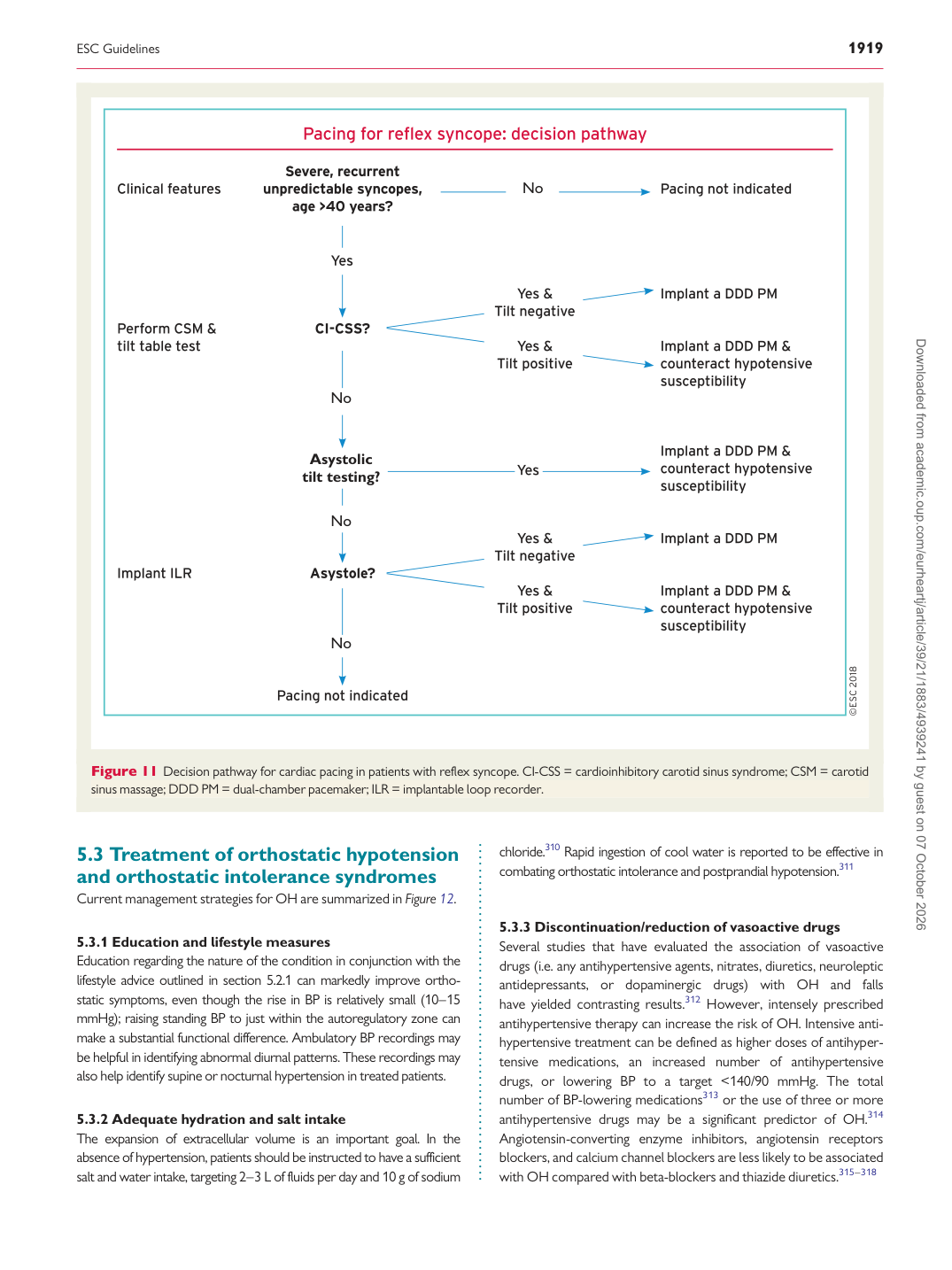
No

No

No No

Asystolic tilt testing?

Figure 11 Decision pathway for cardiac pacing in patients with reflex syncope. CI-CSS = cardioinhibitory carotid sinus syndrome; CSM = carotid sinus massage; DDD PM = dual-chamber pacemaker; ILR = implantable loop recorder. Downloaded from academic.oup.com/eurheartj/article/39/21/1883/4939241 by guest on 07 October 2026