p.36 抽出テキスト
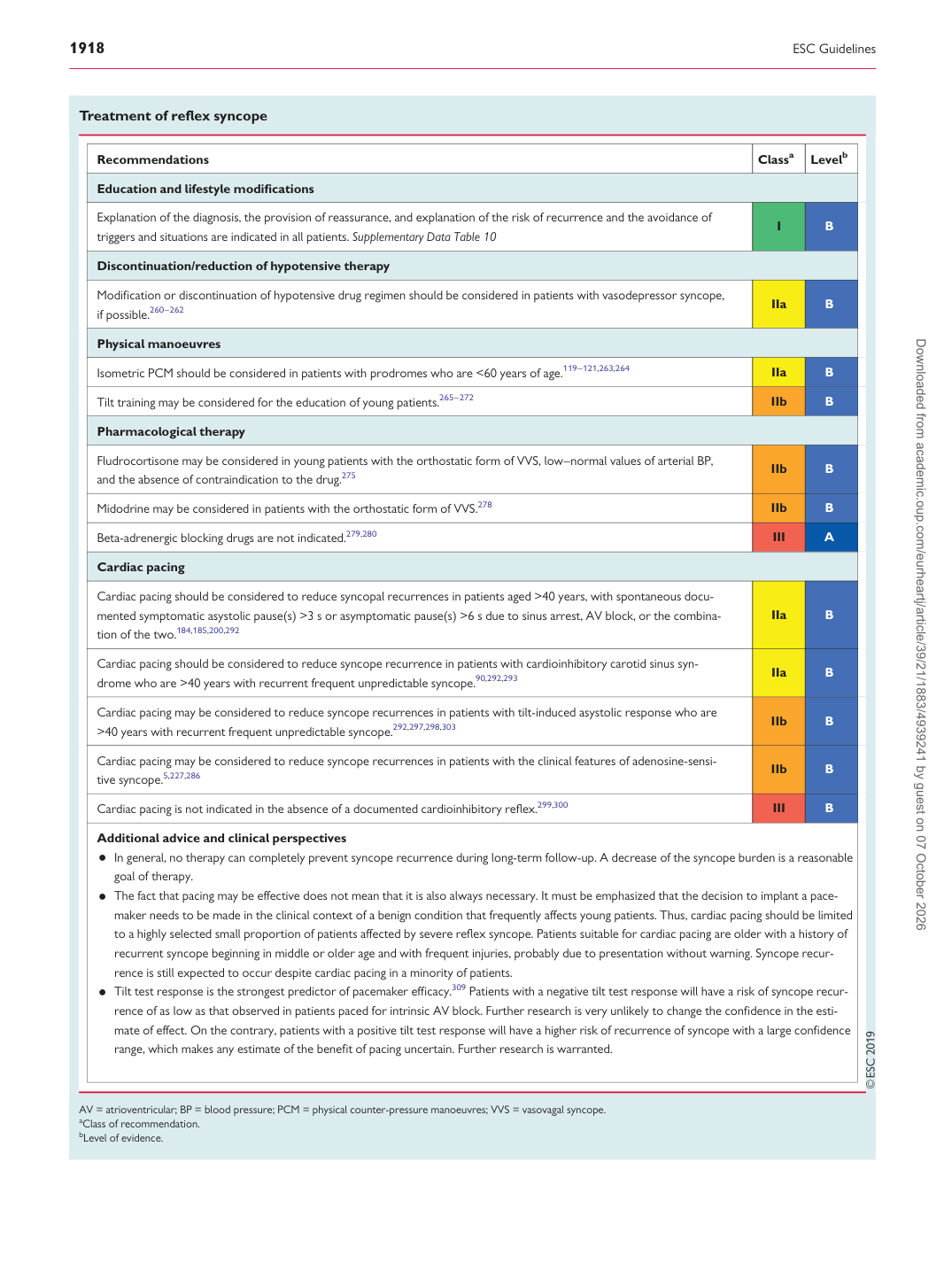
Treatment of reflex syncope

Recommendations Classa Levelb

Education and lifestyle modifications

Explanation of the diagnosis, the provision of reassurance, and explanation of the risk of recurrence and the avoidance of triggers and situations are indicated in all patients. Supplementary Data Table 10 I B

Discontinuation/reduction of hypotensive therapy

Modification or discontinuation of hypotensive drug regimen should be considered in patients with vasodepressor syncope, if possible.260–262 IIa B

Physical manoeuvres Isometric PCM should be considered in patients with prodromes who are <60 years of age.119–121,263,264 IIa B Tilt training may be considered for the education of young patients.265–272 IIb B

Pharmacological therapy

Fludrocortisone may be considered in young patients with the orthostatic form of VVS, low–normal values of arterial BP, and the absence of contraindication to the drug.275 IIb B Midodrine may be considered in patients with the orthostatic form of VVS.278 IIb B Beta-adrenergic blocking drugs are not indicated.279,280 III A

Cardiac pacing

Cardiac pacing should be considered to reduce syncopal recurrences in patients aged >40 years, with spontaneous documented symptomatic asystolic pause(s) >3 s or asymptomatic pause(s) >6 s due to sinus arrest, AV block, or the combination of the two.184,185,200,292 IIa B

Cardiac pacing should be considered to reduce syncope recurrence in patients with cardioinhibitory carotid sinus syndrome who are >40 years with recurrent frequent unpredictable syncope.90,292,293 IIa B

Cardiac pacing may be considered to reduce syncope recurrences in patients with tilt-induced asystolic response who are >40 years with recurrent frequent unpredictable syncope.292,297,298,303 IIb B

Cardiac pacing may be considered to reduce syncope recurrences in patients with the clinical features of adenosine-sensitive syncope.5,227,286 IIb B Cardiac pacing is not indicated in the absence of a documented cardioinhibitory reflex.299,300 III B

Additional advice and clinical perspectives • In general, no therapy can completely prevent syncope recurrence during long-term follow-up. A decrease of the syncope burden is a reasonable goal of therapy. • The fact that pacing may be effective does not mean that it is also always necessary. It must be emphasized that the decision to implant a pace-

maker needs to be made in the clinical context of a benign condition that frequently affects young patients. Thus, cardiac pacing should be limited to a highly selected small proportion of patients affected by severe reflex syncope. Patients suitable for cardiac pacing are older with a history of recurrent syncope beginning in middle or older age and with frequent injuries, probably due to presentation without warning. Syncope recurrence is still expected to occur despite cardiac pacing in a minority of patients. • Tilt test response is the strongest predictor of pacemaker efficacy.309 Patients with a negative tilt test response will have a risk of syncope recur-

rence of as low as that observed in patients paced for intrinsic AV block. Further research is very unlikely to change the confidence in the estimate of effect. On the contrary, patients with a positive tilt test response will have a higher risk of recurrence of syncope with a large confidence range, which makes any estimate of the benefit of pacing uncertain. Further research is warranted.

AV = atrioventricular; BP = blood pressure; PCM = physical counter-pressure manoeuvres; VVS = vasovagal syncope. aClass of recommendation. bLevel of evidence. Downloaded from academic.oup.com/eurheartj/article/39/21/1883/4939241 by guest on 07 October 2026