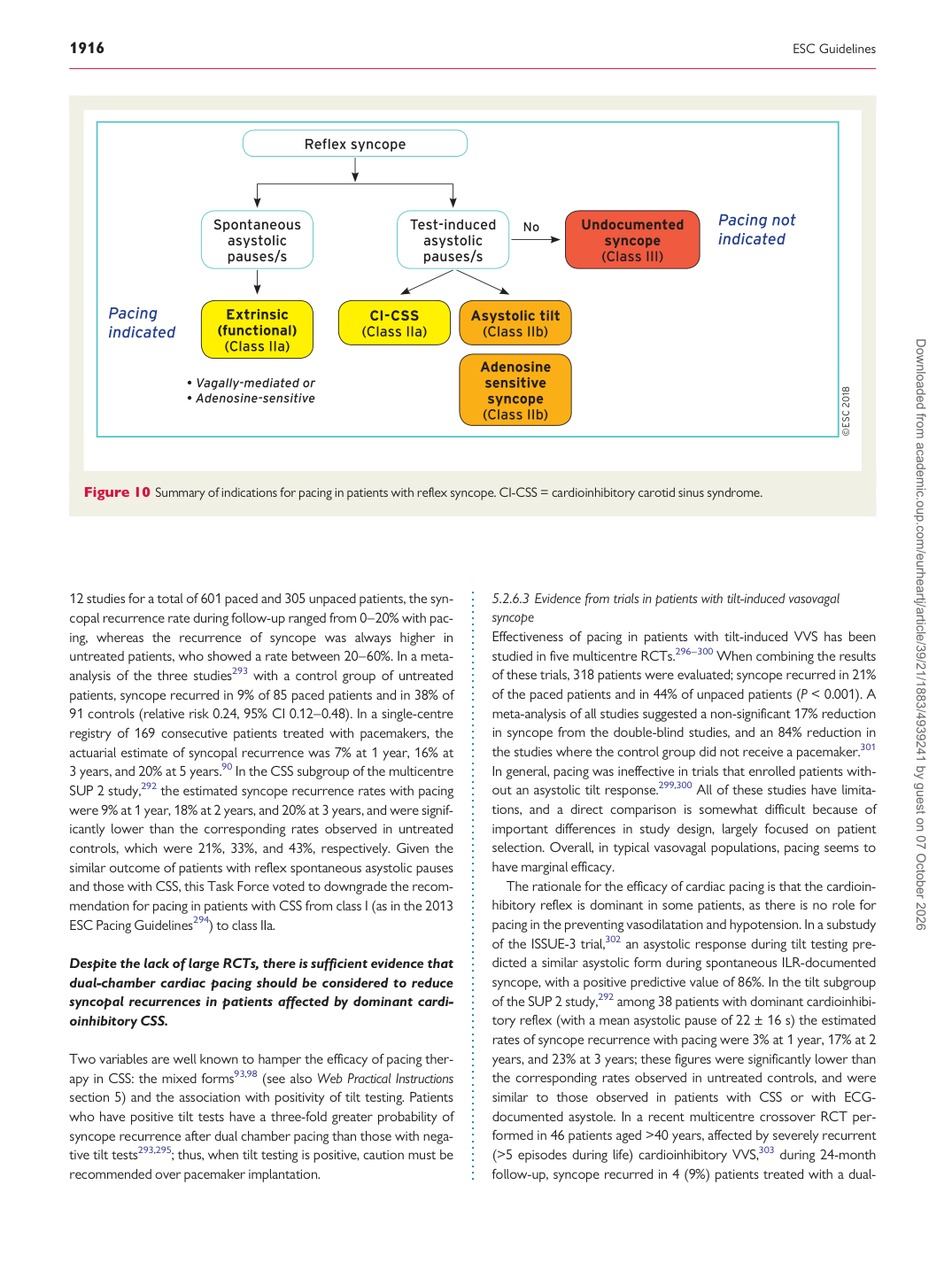
p.34 抽出テキスト
.............................................................................................. 12 studies for a total of 601 paced and 305 unpaced patients, the syncopal recurrence rate during follow-up ranged from 0–20% with pacing, whereas the recurrence of syncope was always higher in untreated patients, who showed a rate between 20–60%. In a metaanalysis of the three studies293 with a control group of untreated patients, syncope recurred in 9% of 85 paced patients and in 38% of 91 controls (relative risk 0.24, 95% CI 0.12–0.48). In a single-centre registry of 169 consecutive patients treated with pacemakers, the actuarial estimate of syncopal recurrence was 7% at 1 year, 16% at 3 years, and 20% at 5 years.90 In the CSS subgroup of the multicentre SUP 2 study,292 the estimated syncope recurrence rates with pacing were 9% at 1 year, 18% at 2 years, and 20% at 3 years, and were significantly lower than the corresponding rates observed in untreated controls, which were 21%, 33%, and 43%, respectively. Given the similar outcome of patients with reflex spontaneous asystolic pauses and those with CSS, this Task Force voted to downgrade the recommendation for pacing in patients with CSS from class I (as in the 2013 ESC Pacing Guidelines294) to class IIa.

Despite the lack of large RCTs, there is sufficient evidence that dual-chamber cardiac pacing should be considered to reduce syncopal recurrences in patients affected by dominant cardioinhibitory CSS.

Two variables are well known to hamper the efficacy of pacing therapy in CSS: the mixed forms93,98 (see also Web Practical Instructions section 5) and the association with positivity of tilt testing. Patients who have positive tilt tests have a three-fold greater probability of syncope recurrence after dual chamber pacing than those with negative tilt tests293,295; thus, when tilt testing is positive, caution must be recommended over pacemaker implantation. 5.2.6.3 Evidence from trials in patients with tilt-induced vasovagal syncope Effectiveness of pacing in patients with tilt-induced VVS has been studied in five multicentre RCTs.296–300 When combining the results of these trials, 318 patients were evaluated; syncope recurred in 21% of the paced patients and in 44% of unpaced patients (P < 0.001). A meta-analysis of all studies suggested a non-significant 17% reduction in syncope from the double-blind studies, and an 84% reduction in the studies where the control group did not receive a pacemaker.301

In general, pacing was ineffective in trials that enrolled patients without an asystolic tilt response.299,300 All of these studies have limitations, and a direct comparison is somewhat difficult because of important differences in study design, largely focused on patient selection. Overall, in typical vasovagal populations, pacing seems to have marginal efficacy. The rationale for the efficacy of cardiac pacing is that the cardioinhibitory reflex is dominant in some patients, as there is no role for pacing in the preventing vasodilatation and hypotension. In a substudy of the ISSUE-3 trial,302 an asystolic response during tilt testing predicted a similar asystolic form during spontaneous ILR-documented syncope, with a positive predictive value of 86%. In the tilt subgroup of the SUP 2 study,292 among 38 patients with dominant cardioinhibitory reflex (with a mean asystolic pause of 22 ± 16 s) the estimated rates of syncope recurrence with pacing were 3% at 1 year, 17% at 2 years, and 23% at 3 years; these figures were significantly lower than the corresponding rates observed in untreated controls, and were similar to those observed in patients with CSS or with ECGdocumented asystole. In a recent multicentre crossover RCT performed in 46 patients aged >40 years, affected by severely recurrent (>5 episodes during life) cardioinhibitory VVS,303 during 24-month follow-up, syncope recurred in 4 (9%) patients treated with a dual-

Figure 10 Summary of indications for pacing in patients with reflex syncope. CI-CSS = cardioinhibitory carotid sinus syndrome. Downloaded from academic.oup.com/eurheartj/article/39/21/1883/4939241 by guest on 07 October 2026