p.29 抽出テキスト
.......................................................................................................................

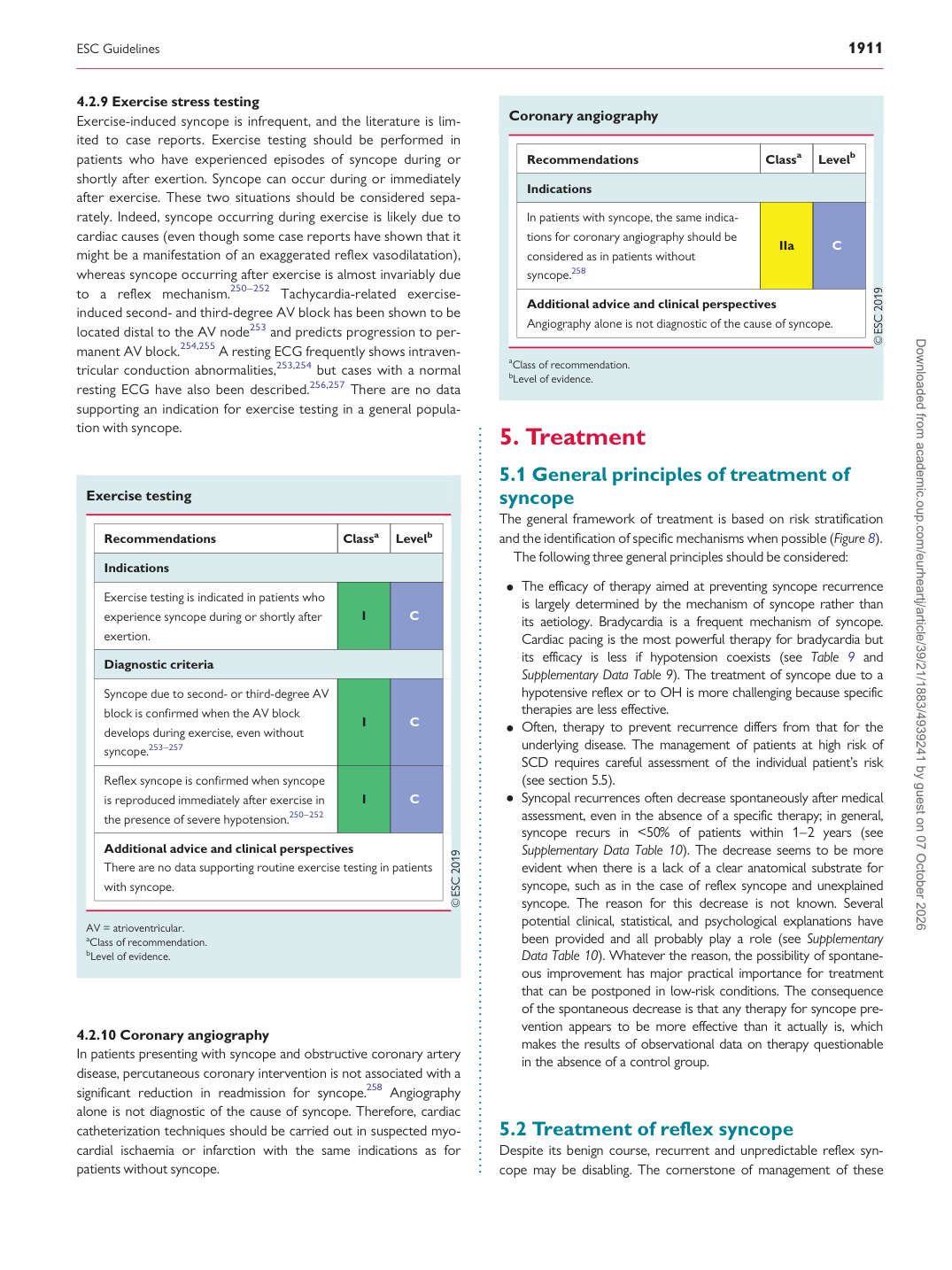
4.2.9 Exercise stress testing Exercise-induced syncope is infrequent, and the literature is limited to case reports. Exercise testing should be performed in patients who have experienced episodes of syncope during or shortly after exertion. Syncope can occur during or immediately after exercise. These two situations should be considered separately. Indeed, syncope occurring during exercise is likely due to cardiac causes (even though some case reports have shown that it might be a manifestation of an exaggerated reflex vasodilatation), whereas syncope occurring after exercise is almost invariably due to a reflex mechanism.250–252 Tachycardia-related exerciseinduced second- and third-degree AV block has been shown to be located distal to the AV node253 and predicts progression to permanent AV block.254,255 A resting ECG frequently shows intraventricular conduction abnormalities,253,254 but cases with a normal resting ECG have also been described.256,257 There are no data supporting an indication for exercise testing in a general population with syncope.

4.2.10 Coronary angiography In patients presenting with syncope and obstructive coronary artery disease, percutaneous coronary intervention is not associated with a significant reduction in readmission for syncope.258 Angiography alone is not diagnostic of the cause of syncope. Therefore, cardiac catheterization techniques should be carried out in suspected myocardial ischaemia or infarction with the same indications as for patients without syncope. 5 Treatment

5.1 General principles of treatment of

syncope The general framework of treatment is based on risk stratification and the identification of specific mechanisms when possible (Figure 8).

The following three general principles should be considered: • The efficacy of therapy aimed at preventing syncope recurrence is largely determined by the mechanism of syncope rather than its aetiology. Bradycardia is a frequent mechanism of syncope. Cardiac pacing is the most powerful therapy for bradycardia but its efficacy is less if hypotension coexists (see Table 9 and Supplementary Data Table 9). The treatment of syncope due to a hypotensive reflex or to OH is more challenging because specific therapies are less effective. • Often, therapy to prevent recurrence differs from that for the underlying disease. The management of patients at high risk of SCD requires careful assessment of the individual patient’s risk (see section 5.5). • Syncopal recurrences often decrease spontaneously after medical assessment, even in the absence of a specific therapy; in general, syncope recurs in <50% of patients within 1–2 years (see Supplementary Data Table 10). The decrease seems to be more evident when there is a lack of a clear anatomical substrate for syncope, such as in the case of reflex syncope and unexplained syncope. The reason for this decrease is not known. Several potential clinical, statistical, and psychological explanations have been provided and all probably play a role (see Supplementary Data Table 10). Whatever the reason, the possibility of spontaneous improvement has major practical importance for treatment that can be postponed in low-risk conditions. The consequence of the spontaneous decrease is that any therapy for syncope prevention appears to be more effective than it actually is, which makes the results of observational data on therapy questionable in the absence of a control group.

5.2 Treatment of reflex syncope

Despite its benign course, recurrent and unpredictable reflex syncope may be disabling. The cornerstone of management of these

Exercise testing

Recommendations Classa Levelb

Indications

Exercise testing is indicated in patients who experience syncope during or shortly after exertion. I C

Diagnostic criteria

Syncope due to second- or third-degree AV block is confirmed when the AV block develops during exercise, even without syncope.253–257 I C

Reflex syncope is confirmed when syncope is reproduced immediately after exercise in the presence of severe hypotension.250–252 I C

Additional advice and clinical perspectives There are no data supporting routine exercise testing in patients with syncope.

AV = atrioventricular. aClass of recommendation. bLevel of evidence. Coronary angiography

Recommendations Classa Levelb

Indications

In patients with syncope, the same indications for coronary angiography should be considered as in patients without syncope.258 IIa C

Additional advice and clinical perspectives Angiography alone is not diagnostic of the cause of syncope.

aClass of recommendation. bLevel of evidence. Downloaded from academic.oup.com/eurheartj/article/39/21/1883/4939241 by guest on 07 October 2026