p.27 抽出テキスト
................................. 4.2.7 Endogenous adenosine and other biomarkers Established cardiac biomarkers such as troponin and B-type natriuretic peptide have been used to distinguish cardiac from non-cardiac syncope and identify structural heart disease.223–225

4.2.7.1 Adenosine (triphosphate) test and plasma concentration The purinergic signalling system, including adenosine and its receptors, has been proposed to be involved in unexplained syncope without prodrome.4,226 A low plasma adenosine level is associated with paroxysmal AV block or CSS, whereas a high level is seen in those with a hypotensive/vasodepressive tendency and VVS. In parallel, the adenosine/adenosine triphosphate (ATP) provocation test has been performed to demonstrate the utility of adenosine sensitivity and paroxysmal cardioinhibitory propensity for the selection of appropriate pacemaker candidates.4,227,228 The test requires rapid (<2 s) injection of a 20 mg bolus of ATP/adenosine during ECG monitoring. The induction of AV block with ventricular asystole lasting >6 s, or the induction of AV block lasting >10 s, is considered abnormal. ATP testing was positive in most patients with syncope of unknown origin (especially syncope without prodrome and without structural heart disease4) but not in controls, suggesting that paroxysmal AV

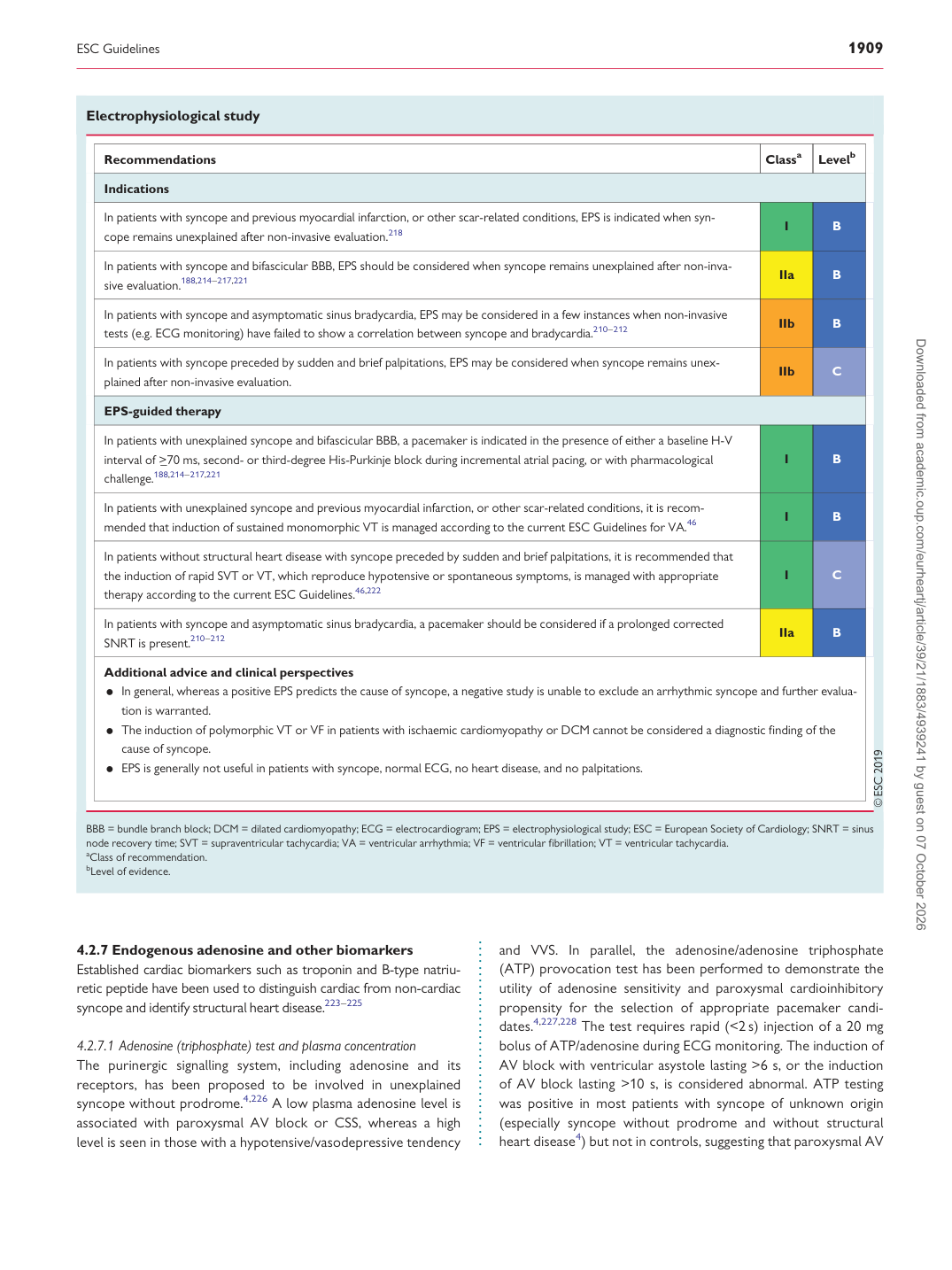
Electrophysiological study

Recommendations Classa Levelb

Indications

In patients with syncope and previous myocardial infarction, or other scar-related conditions, EPS is indicated when syncope remains unexplained after non-invasive evaluation.218 I B

In patients with syncope and bifascicular BBB, EPS should be considered when syncope remains unexplained after non-invasive evaluation.188,214–217,221 IIa B

In patients with syncope and asymptomatic sinus bradycardia, EPS may be considered in a few instances when non-invasive tests (e.g. ECG monitoring) have failed to show a correlation between syncope and bradycardia.210–212 IIb B

In patients with syncope preceded by sudden and brief palpitations, EPS may be considered when syncope remains unexplained after non-invasive evaluation. IIb C

EPS-guided therapy

In patients with unexplained syncope and bifascicular BBB, a pacemaker is indicated in the presence of either a baseline H-V interval of >_70 ms, second- or third-degree His-Purkinje block during incremental atrial pacing, or with pharmacological challenge.188,214–217,221 I B

In patients with unexplained syncope and previous myocardial infarction, or other scar-related conditions, it is recommended that induction of sustained monomorphic VT is managed according to the current ESC Guidelines for VA.46 I B

In patients without structural heart disease with syncope preceded by sudden and brief palpitations, it is recommended that the induction of rapid SVT or VT, which reproduce hypotensive or spontaneous symptoms, is managed with appropriate therapy according to the current ESC Guidelines.46,222 I C

In patients with syncope and asymptomatic sinus bradycardia, a pacemaker should be considered if a prolonged corrected SNRT is present.210–212 IIa B

Additional advice and clinical perspectives • In general, whereas a positive EPS predicts the cause of syncope, a negative study is unable to exclude an arrhythmic syncope and further evaluation is warranted. • The induction of polymorphic VT or VF in patients with ischaemic cardiomyopathy or DCM cannot be considered a diagnostic finding of the cause of syncope. • EPS is generally not useful in patients with syncope, normal ECG, no heart disease, and no palpitations.

BBB = bundle branch block; DCM = dilated cardiomyopathy; ECG = electrocardiogram; EPS = electrophysiological study; ESC = European Society of Cardiology; SNRT = sinus node recovery time; SVT = supraventricular tachycardia; VA = ventricular arrhythmia; VF = ventricular fibrillation; VT = ventricular tachycardia. aClass of recommendation. bLevel of evidence. Downloaded from academic.oup.com/eurheartj/article/39/21/1883/4939241 by guest on 07 October 2026