p.26 抽出テキスト
............................................................................................................................................................................. are not low; adding an EEG increases the diagnostic probability of PPS even further. The method has been proven to show the combined presence of VVS and PPS.117

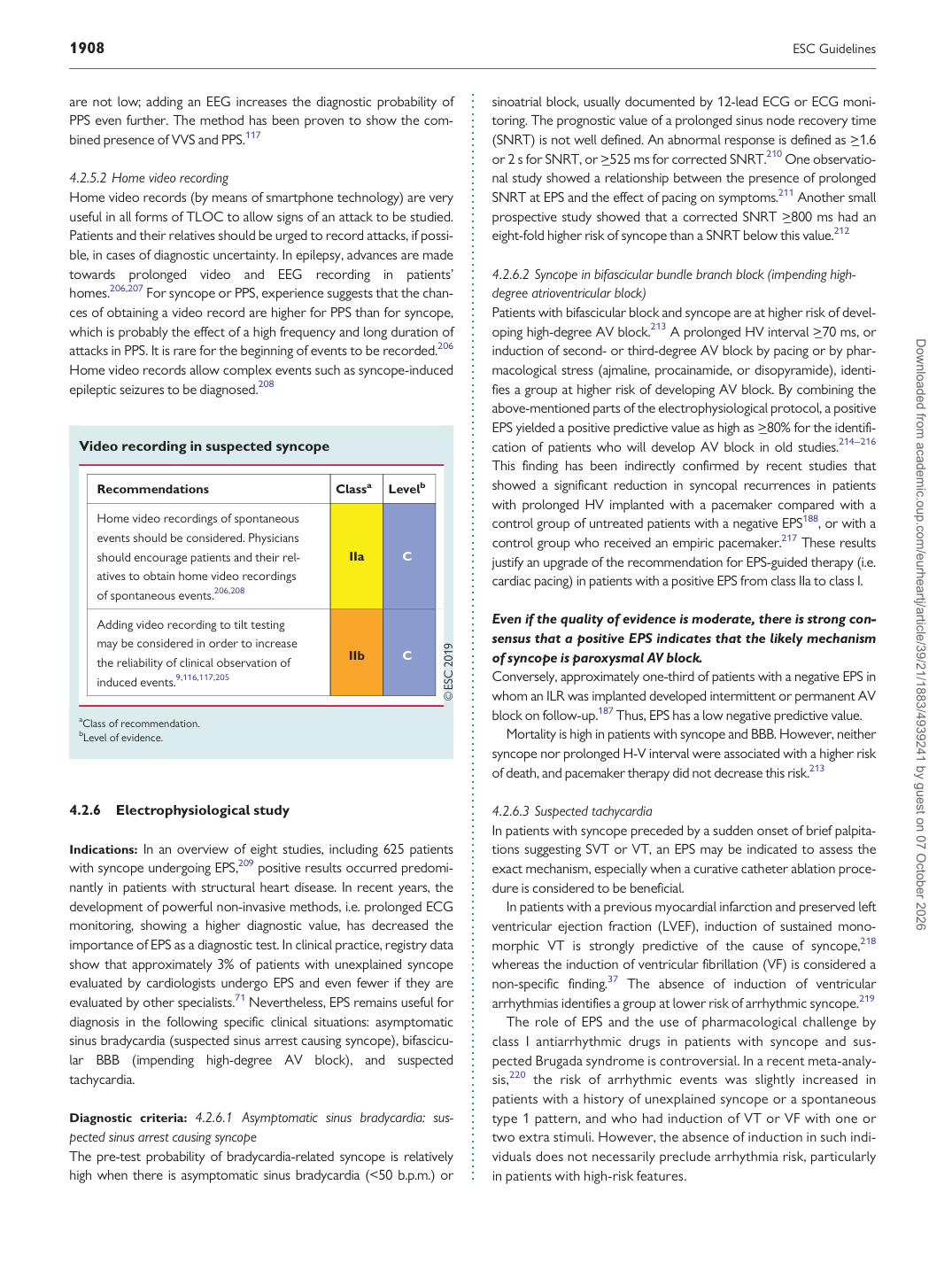
4.2.5.2 Home video recording Home video records (by means of smartphone technology) are very useful in all forms of TLOC to allow signs of an attack to be studied. Patients and their relatives should be urged to record attacks, if possible, in cases of diagnostic uncertainty. In epilepsy, advances are made towards prolonged video and EEG recording in patients’ homes.206,207 For syncope or PPS, experience suggests that the chances of obtaining a video record are higher for PPS than for syncope, which is probably the effect of a high frequency and long duration of attacks in PPS. It is rare for the beginning of events to be recorded.206 Home video records allow complex events such as syncope-induced epileptic seizures to be diagnosed.208

4.2.6 Electrophysiological study

Indications: In an overview of eight studies, including 625 patients with syncope undergoing EPS,209 positive results occurred predominantly in patients with structural heart disease. In recent years, the development of powerful non-invasive methods, i.e. prolonged ECG monitoring, showing a higher diagnostic value, has decreased the importance of EPS as a diagnostic test. In clinical practice, registry data show that approximately 3% of patients with unexplained syncope evaluated by cardiologists undergo EPS and even fewer if they are evaluated by other specialists.71 Nevertheless, EPS remains useful for diagnosis in the following specific clinical situations: asymptomatic sinus bradycardia (suspected sinus arrest causing syncope), bifascicular BBB (impending high-degree AV block), and suspected tachycardia.

Diagnostic criteria: 4.2.6.1 Asymptomatic sinus bradycardia: suspected sinus arrest causing syncope The pre-test probability of bradycardia-related syncope is relatively high when there is asymptomatic sinus bradycardia (<50 b.p.m.) or sinoatrial block, usually documented by 12-lead ECG or ECG monitoring. The prognostic value of a prolonged sinus node recovery time (SNRT) is not well defined. An abnormal response is defined as >_1.6 or 2 s for SNRT, or >_525 ms for corrected SNRT.210 One observational study showed a relationship between the presence of prolonged SNRT at EPS and the effect of pacing on symptoms.211 Another small prospective study showed that a corrected SNRT >_800 ms had an eight-fold higher risk of syncope than a SNRT below this value.212

4.2.6.2 Syncope in bifascicular bundle branch block (impending highdegree atrioventricular block) Patients with bifascicular block and syncope are at higher risk of developing high-degree AV block.213 A prolonged HV interval >_70 ms, or induction of second- or third-degree AV block by pacing or by pharmacological stress (ajmaline, procainamide, or disopyramide), identifies a group at higher risk of developing AV block. By combining the above-mentioned parts of the electrophysiological protocol, a positive EPS yielded a positive predictive value as high as >_80% for the identification of patients who will develop AV block in old studies.214–216 This finding has been indirectly confirmed by recent studies that showed a significant reduction in syncopal recurrences in patients with prolonged HV implanted with a pacemaker compared with a control group of untreated patients with a negative EPS188, or with a control group who received an empiric pacemaker.217 These results justify an upgrade of the recommendation for EPS-guided therapy (i.e. cardiac pacing) in patients with a positive EPS from class IIa to class I.

Even if the quality of evidence is moderate, there is strong consensus that a positive EPS indicates that the likely mechanism of syncope is paroxysmal AV block. Conversely, approximately one-third of patients with a negative EPS in whom an ILR was implanted developed intermittent or permanent AV block on follow-up.187 Thus, EPS has a low negative predictive value. Mortality is high in patients with syncope and BBB. However, neither syncope nor prolonged H-V interval were associated with a higher risk of death, and pacemaker therapy did not decrease this risk.213

4.2.6.3 Suspected tachycardia In patients with syncope preceded by a sudden onset of brief palpitations suggesting SVT or VT, an EPS may be indicated to assess the exact mechanism, especially when a curative catheter ablation procedure is considered to be beneficial. In patients with a previous myocardial infarction and preserved left ventricular ejection fraction (LVEF), induction of sustained monomorphic VT is strongly predictive of the cause of syncope,218 whereas the induction of ventricular fibrillation (VF) is considered a non-specific finding.37 The absence of induction of ventricular arrhythmias identifies a group at lower risk of arrhythmic syncope.219 The role of EPS and the use of pharmacological challenge by class I antiarrhythmic drugs in patients with syncope and suspected Brugada syndrome is controversial. In a recent meta-analysis,220 the risk of arrhythmic events was slightly increased in patients with a history of unexplained syncope or a spontaneous type 1 pattern, and who had induction of VT or VF with one or two extra stimuli. However, the absence of induction in such individuals does not necessarily preclude arrhythmia risk, particularly in patients with high-risk features.

Video recording in suspected syncope

Recommendations Classa Levelb

Home video recordings of spontaneous events should be considered. Physicians should encourage patients and their relatives to obtain home video recordings of spontaneous events.206,208 IIa C

Adding video recording to tilt testing may be considered in order to increase the reliability of clinical observation of induced events.9,116,117,205 IIb C

aClass of recommendation. bLevel of evidence. Downloaded from academic.oup.com/eurheartj/article/39/21/1883/4939241 by guest on 07 October 2026