p.25 抽出テキスト
.................. 4.2.5 Video recording in suspected syncope 4.2.5.1 In-hospital video recording For PNES, a video-electroencephalogram (EEG) forms the highest level of diagnostic probability.204 For syncope and PPS, video can play a similar, probably underused, role (see section 7). Adding video recording to a tilt table test adds the ability to review clinical signs in relation to BP and HR objectively and repeatedly, thus helping to distinguish VVS from PPS. This approach has revealed new pathophysiological insights in syncope.9 Attaching the camera to the tilt table allows detailed study of the face and head, which is useful when assessing the start and end of LOC.9,205 Video recording of tiltinduced PPS116 ensures that apparent TLOC occurs while BP and HR

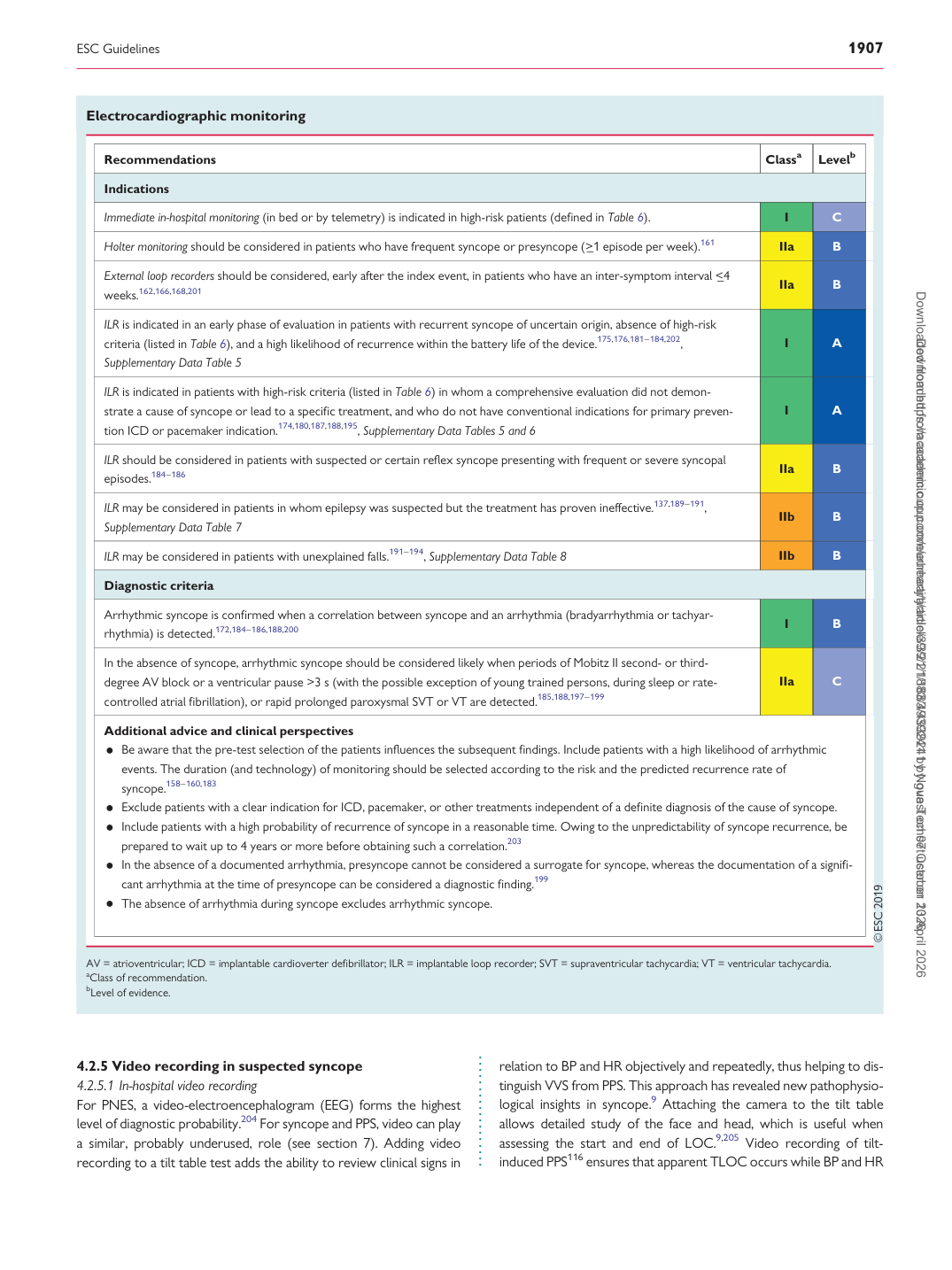
Electrocardiographic monitoring

Recommendations Classa Levelb

Indications

Immediate in-hospital monitoring (in bed or by telemetry) is indicated in high-risk patients (defined in Table 6). I C Holter monitoring should be considered in patients who have frequent syncope or presyncope (>_1 episode per week).161 IIa B

External loop recorders should be considered, early after the index event, in patients who have an inter-symptom interval <_4 weeks.162,166,168,201 IIa B

ILR is indicated in an early phase of evaluation in patients with recurrent syncope of uncertain origin, absence of high-risk criteria (listed in Table 6), and a high likelihood of recurrence within the battery life of the device.175,176,181–184,202, Supplementary Data Table 5 I A

ILR is indicated in patients with high-risk criteria (listed in Table 6) in whom a comprehensive evaluation did not demonstrate a cause of syncope or lead to a specific treatment, and who do not have conventional indications for primary prevention ICD or pacemaker indication.174,180,187,188,195, Supplementary Data Tables 5 and 6 I A

ILR should be considered in patients with suspected or certain reflex syncope presenting with frequent or severe syncopal episodes.184–186 IIa B ILR may be considered in patients in whom epilepsy was suspected but the treatment has proven ineffective.137,189–191, Supplementary Data Table 7 IIb B ILR may be considered in patients with unexplained falls.191–194, Supplementary Data Table 8 IIb B

Diagnostic criteria

Arrhythmic syncope is confirmed when a correlation between syncope and an arrhythmia (bradyarrhythmia or tachyarrhythmia) is detected.172,184–186,188,200 I B

In the absence of syncope, arrhythmic syncope should be considered likely when periods of Mobitz II second- or thirddegree AV block or a ventricular pause >3 s (with the possible exception of young trained persons, during sleep or ratecontrolled atrial fibrillation), or rapid prolonged paroxysmal SVT or VT are detected.185,188,197–199 IIa C

Additional advice and clinical perspectives • Be aware that the pre-test selection of the patients influences the subsequent findings. Include patients with a high likelihood of arrhythmic events. The duration (and technology) of monitoring should be selected according to the risk and the predicted recurrence rate of

syncope.158–160,183 • Exclude patients with a clear indication for ICD, pacemaker, or other treatments independent of a definite diagnosis of the cause of syncope. • Include patients with a high probability of recurrence of syncope in a reasonable time. Owing to the unpredictability of syncope recurrence, be

prepared to wait up to 4 years or more before obtaining such a correlation.203 • In the absence of a documented arrhythmia, presyncope cannot be considered a surrogate for syncope, whereas the documentation of a signifi-

cant arrhythmia at the time of presyncope can be considered a diagnostic finding.199 • The absence of arrhythmia during syncope excludes arrhythmic syncope.

AV = atrioventricular; ICD = implantable cardioverter defibrillator; ILR = implantable loop recorder; SVT = supraventricular tachycardia; VT = ventricular tachycardia. aClass of recommendation. bLevel of evidence. Downloaded from https://academic.oup.com/eurheartj/article/39/21/1883/4939241 by Nova Techset user on 13 April 2026 Downloaded from academic.oup.com/eurheartj/article/39/21/1883/4939241 by guest on 07 October 2026