p.23 抽出テキスト
.......................................... 4.2.4 Electrocardiographic monitoring (non-invasive and invasive) The role of ECG monitoring cannot be defined in isolation. As a rule, ECG monitoring is indicated only when there is a high pre-test probability of identifying an arrhythmia associated with syncope, such as those listed in Table 5.

4.2.4.1 In-hospital monitoring In-hospital monitoring (in bed or by telemetry) is warranted in patients with high-risk clinical features (defined in Table 6) suggesting arrhythmic syncope, especially if the monitoring is applied immediately after syncope. Although the diagnostic yield of ECG monitoring varies from 1.9–17.6%,158–160 it is justified by the need to avoid immediate risk to the patient. 4.2.4.2 Holter monitoring Since, in most patients, symptoms do not recur during monitoring, the true yield of Holter monitoring in syncope may be as low as 1–2% in an unselected population. In 15% of patients, symptoms were not associated with arrhythmia.161 Thus, in these patients, a rhythm disturbance could potentially be excluded as a cause of syncope. Holter monitoring in syncope is inexpensive in terms of set-up costs, but expensive in terms of cost per diagnosis.162 Holter monitoring in syncope may be of more value if symptoms are frequent. Daily single or multiple episodes of LOC might increase the potential for symptom–ECG correlation.

4.2.4.3 Prospective external event recorders Event recorders are external devices that are applied by the patient when symptoms occur. Whereas these recorders can be useful in

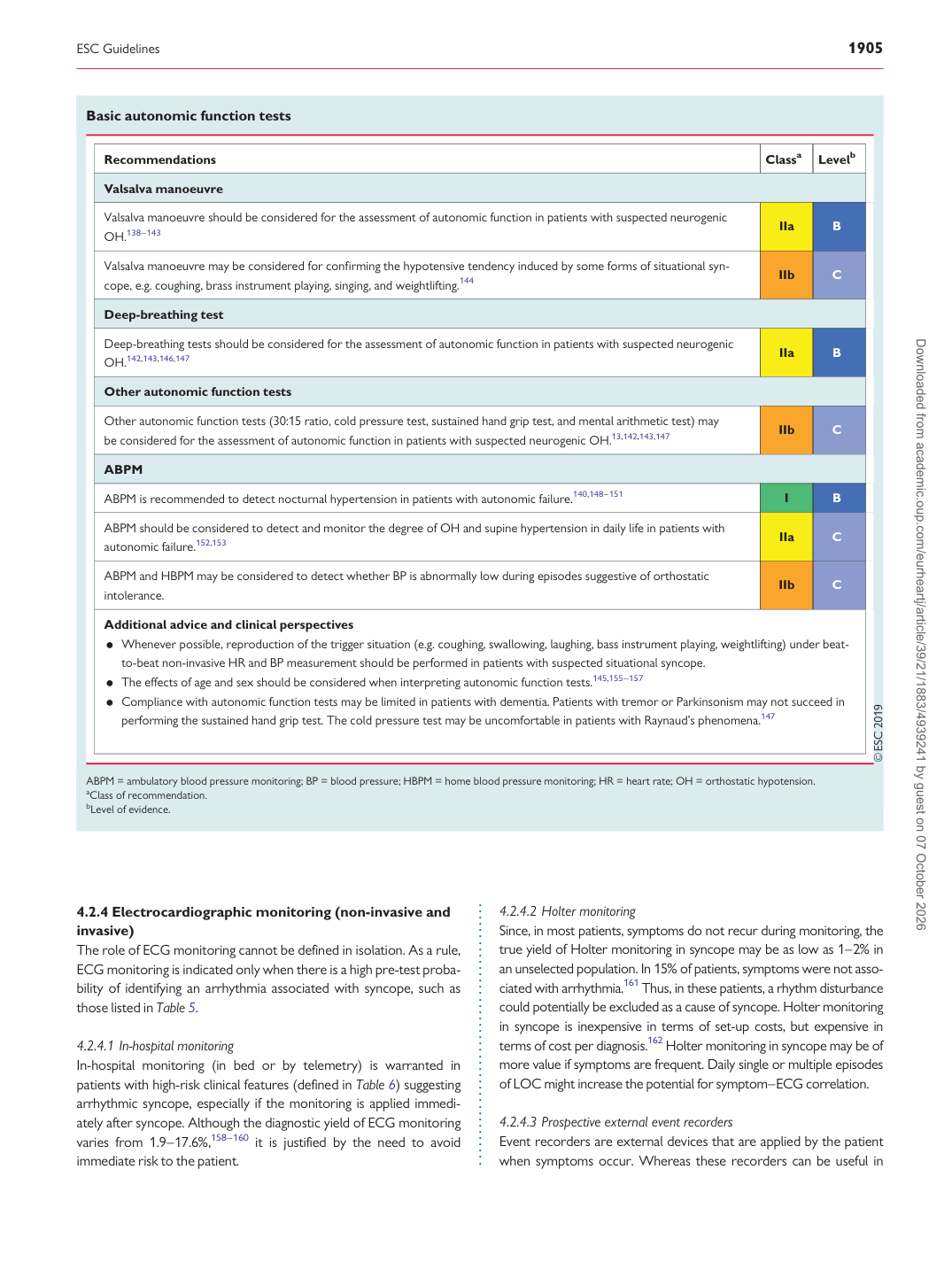
Basic autonomic function tests

Recommendations Classa Levelb

Valsalva manoeuvre

Valsalva manoeuvre should be considered for the assessment of autonomic function in patients with suspected neurogenic OH.138–143 IIa B

Valsalva manoeuvre may be considered for confirming the hypotensive tendency induced by some forms of situational syncope, e.g. coughing, brass instrument playing, singing, and weightlifting.144 IIb C

Deep-breathing test

Deep-breathing tests should be considered for the assessment of autonomic function in patients with suspected neurogenic OH.142,143,146,147 IIa B

Other autonomic function tests

Other autonomic function tests (30:15 ratio, cold pressure test, sustained hand grip test, and mental arithmetic test) may be considered for the assessment of autonomic function in patients with suspected neurogenic OH.13,142,143,147 IIb C

ABPM ABPM is recommended to detect nocturnal hypertension in patients with autonomic failure.140,148–151 I B

ABPM should be considered to detect and monitor the degree of OH and supine hypertension in daily life in patients with autonomic failure.152,153 IIa C

ABPM and HBPM may be considered to detect whether BP is abnormally low during episodes suggestive of orthostatic intolerance. IIb C

Additional advice and clinical perspectives • Whenever possible, reproduction of the trigger situation (e.g. coughing, swallowing, laughing, bass instrument playing, weightlifting) under beatto-beat non-invasive HR and BP measurement should be performed in patients with suspected situational syncope. • The effects of age and sex should be considered when interpreting autonomic function tests.145,155–157 • Compliance with autonomic function tests may be limited in patients with dementia. Patients with tremor or Parkinsonism may not succeed in

performing the sustained hand grip test. The cold pressure test may be uncomfortable in patients with Raynaud’s phenomena.147

ABPM = ambulatory blood pressure monitoring; BP = blood pressure; HBPM = home blood pressure monitoring; HR = heart rate; OH = orthostatic hypotension. aClass of recommendation. bLevel of evidence. Downloaded from academic.oup.com/eurheartj/article/39/21/1883/4939241 by guest on 07 October 2026