p.21 抽出テキスト
...................................................................... 4.2.2.2 Tilt testing Since its introduction in 1986,105 many protocols have been reported with variations in the initial stabilization phase, duration, tilt angle, type of support, and pharmacological provocation. The most commonly used are the trinitroglycerin (TNG) test using 300–400 mg of sublingual TNG after a 20-min unmedicated phase,106,107 and the low-dose intravenous isoproterenol test, which uses incremental doses to increase average HR by about 20–25% over baseline (usually <_3 mg/min).108,109 In a recent systematic literature review,110 the overall positivity rate in patients with syncope was 66% for the TNG protocol and 61% for the isoproterenol protocol; the respective positivity rate in subjects without syncope (controls) ranged from 11–14%; and the test differentiated patients with syncope from controls with an odds ratio of 12. The methodology and classification of responses are described in section 6 of the Web Practical Instructions. Adding video recording to a tilt table permits objective and repeated review of clinical signs in relation to BP and HR, and helps to assess the relative contribution of bradycardia and hypotension to syncope (see section 5.2.6.3 and the explanatory video in Web Practical Instructions section 6.3.15), and to distinguish between VVS and PPS (see section 4.2.5).

The clinical situation corresponding to tilt-induced syncope is that which is triggered by prolonged standing. The test should be considered: (i) to confirm a diagnosis of reflex syncope in patients in whom this diagnosis was suspected but not confirmed by initial evaluation105–109,111, and (ii) for the assessment of autonomic failure, especially for the reproduction of delayed OH (which could not be detected by active standing because of its delayed onset)23,24,112,113

and postural orthostatic tachycardia syndrome (POTS).114 Tilt testing may be helpful in separating syncope from PPS.115–117

Tilt testing has limited value in assessing treatment efficacy.118 However, tilt testing is widely accepted as a useful tool to demonstrate susceptibility of the patient to reflex syncope, especially a hypotensive (vasodepressive) tendency, and thereby to initiate treatment (e.g. physical manoeuvres, see section 5).119–121 The endpoint of tilt testing is the reproduction of symptoms along with the characteristic circulatory pattern of the indication mentioned above, namely the induction of reflex hypotension/bradycardia, OH, POTS, or PPS. The typical tilt test result patterns are shown in the Web Practical Instructions section 6.

Interpretation of tilt testing results in patients with reflex syncope: Some studies122,123 compared the response to tilt testing with spontaneous syncope recorded by an implantable loop recorder (ILR). While a positive cardioinhibitory response to tilt testing predicts, with a high probability, an asystolic spontaneous syncope, the presence of a

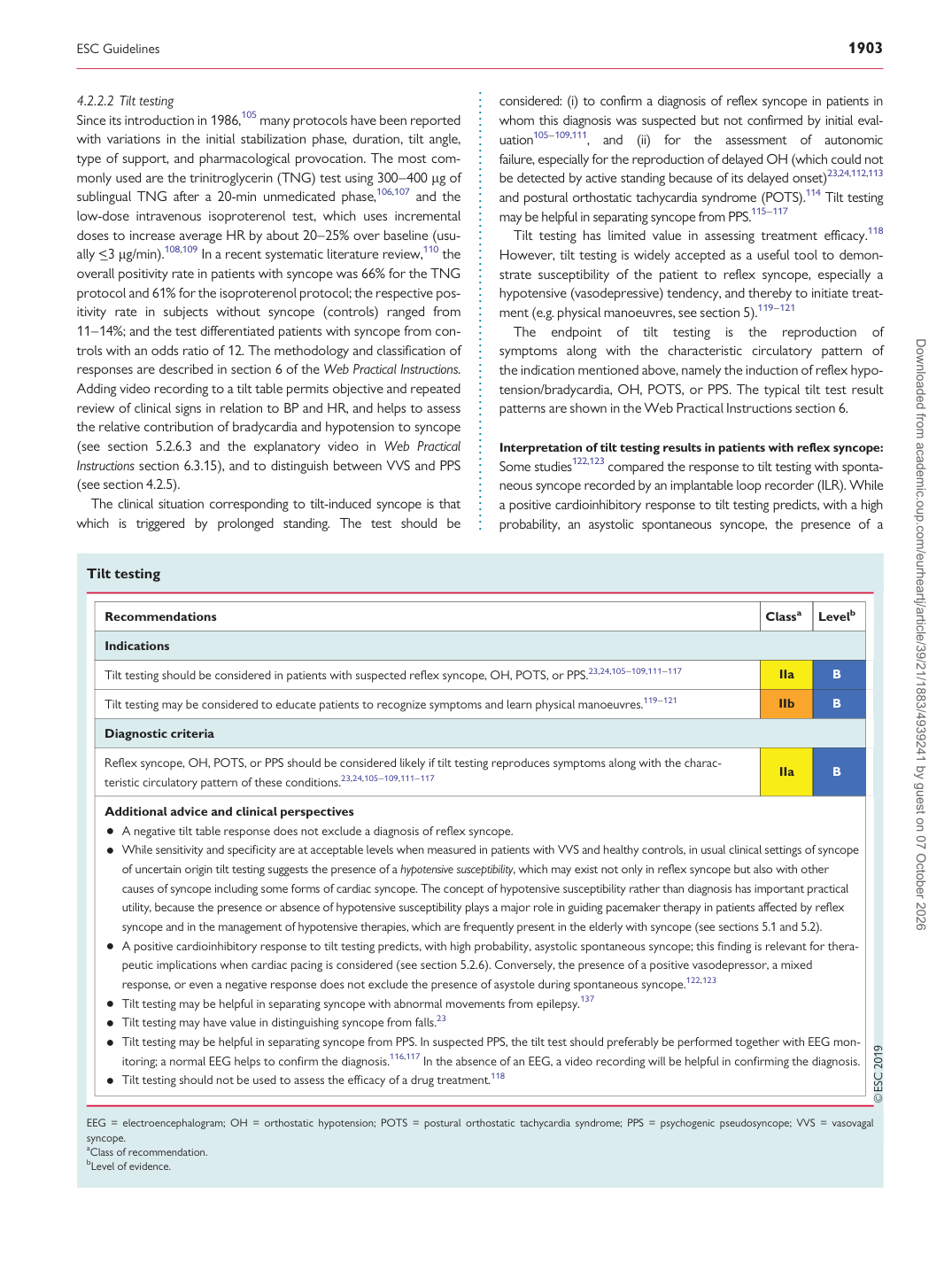
Tilt testing

Recommendations Classa Levelb

Indications Tilt testing should be considered in patients with suspected reflex syncope, OH, POTS, or PPS.23,24,105–109,111–117 IIa B Tilt testing may be considered to educate patients to recognize symptoms and learn physical manoeuvres.119–121 IIb B

Diagnostic criteria

Reflex syncope, OH, POTS, or PPS should be considered likely if tilt testing reproduces symptoms along with the characteristic circulatory pattern of these conditions.23,24,105–109,111–117 IIa B

Additional advice and clinical perspectives • A negative tilt table response does not exclude a diagnosis of reflex syncope. • While sensitivity and specificity are at acceptable levels when measured in patients with VVS and healthy controls, in usual clinical settings of syncope

of uncertain origin tilt testing suggests the presence of a hypotensive susceptibility, which may exist not only in reflex syncope but also with other causes of syncope including some forms of cardiac syncope. The concept of hypotensive susceptibility rather than diagnosis has important practical utility, because the presence or absence of hypotensive susceptibility plays a major role in guiding pacemaker therapy in patients affected by reflex syncope and in the management of hypotensive therapies, which are frequently present in the elderly with syncope (see sections 5.1 and 5.2). • A positive cardioinhibitory response to tilt testing predicts, with high probability, asystolic spontaneous syncope; this finding is relevant for thera-

peutic implications when cardiac pacing is considered (see section 5.2.6). Conversely, the presence of a positive vasodepressor, a mixed response, or even a negative response does not exclude the presence of asystole during spontaneous syncope.122,123 • Tilt testing may be helpful in separating syncope with abnormal movements from epilepsy.137 • Tilt testing may have value in distinguishing syncope from falls.23 • Tilt testing may be helpful in separating syncope from PPS. In suspected PPS, the tilt test should preferably be performed together with EEG monitoring; a normal EEG helps to confirm the diagnosis.116,117 In the absence of an EEG, a video recording will be helpful in confirming the diagnosis. • Tilt testing should not be used to assess the efficacy of a drug treatment.118

EEG = electroencephalogram; OH = orthostatic hypotension; POTS = postural orthostatic tachycardia syndrome; PPS = psychogenic pseudosyncope; VVS = vasovagal syncope. aClass of recommendation. bLevel of evidence. Downloaded from academic.oup.com/eurheartj/article/39/21/1883/4939241 by guest on 07 October 2026