p.19 抽出テキスト
..............

............................................................

There is strong consensus that the diagnosis of CSS requires both the reproduction of spontaneous symptoms during CSM and clinical features of spontaneous syncope compatible with a reflex mechanism. The quality of evidence is moderate and is given by studies of ECG correlation between CSM and sponta- neous events, and indirectly by studies of efficacy of cardiac pacing. Further research is likely to have an important impact on our confidence in the estimation of effect and may change the estimate.

4.2.2 Orthostatic challenge Changing from the supine to the upright position produces a displacement of blood from the thorax to the lower limbs and abdominal cavity that leads to a decrease in venous return and cardiac output. In the absence of compensatory mechanisms, a fall in BP may lead to syncope.20,103,104 The diagnostic criteria for OH have been defined by consensus.6 Currently, there are three methods for assessing the response to change in posture from supine to erect20,103,104: active standing (see section 4.2.2.1), head-up tilt (see section 4.2.2.2), and 24-h ambulatory BP monitoring (ABPM) (see section 4.2.3.4).

4.2.2.1 Active standing

Indications: This test is used to diagnose different types of orthostatic intolerance (see Web Practical Instructions Web Table 1). A sphygmomanometer is adequate for routine clinical testing for classical OH and delayed OH because of its ubiquity and simplicity. Automatic arm-cuff devices, which are programmed to repeat and confirm measurements when discrepant values are recorded, are at a disadvantage due to the rapidly falling BP during OH. With a sphygmomanometer, more than four measurements per minute cannot be obtained without venous obstruction in the arm. When more frequent readings are required, as for initial OH, continuous beat-tobeat non-invasive BP measurement is needed.20,103,104

Diagnostic criteria: Abnormal BP fall is defined as a progressive and sustained fall in systolic BP from baseline value >_20 mmHg or diastolic BP >_10 mmHg, or a decrease in systolic BP to <90 mmHg. This definition of OH differs from the 2011 consensus6 in adding the 90 mmHg threshold. This Task Force believes that an absolute threshold of 90 mmHg of systolic BP is useful, especially in patients with a supine BP <110 mmHg. An isolated diastolic BP drop is very rare and its clinical relevance for OH diagnosis is limited. Orthostatic heart rate (HR) increase is blunted or absent [usually not >10 beats per minute (b.p.m.)] in patients with neurogenic OH, but increases or even exaggerates with anaemia or hypovolaemia. The probability that syncope and orthostatic complaints are due to OH can be assessed using the information given in Table 8.

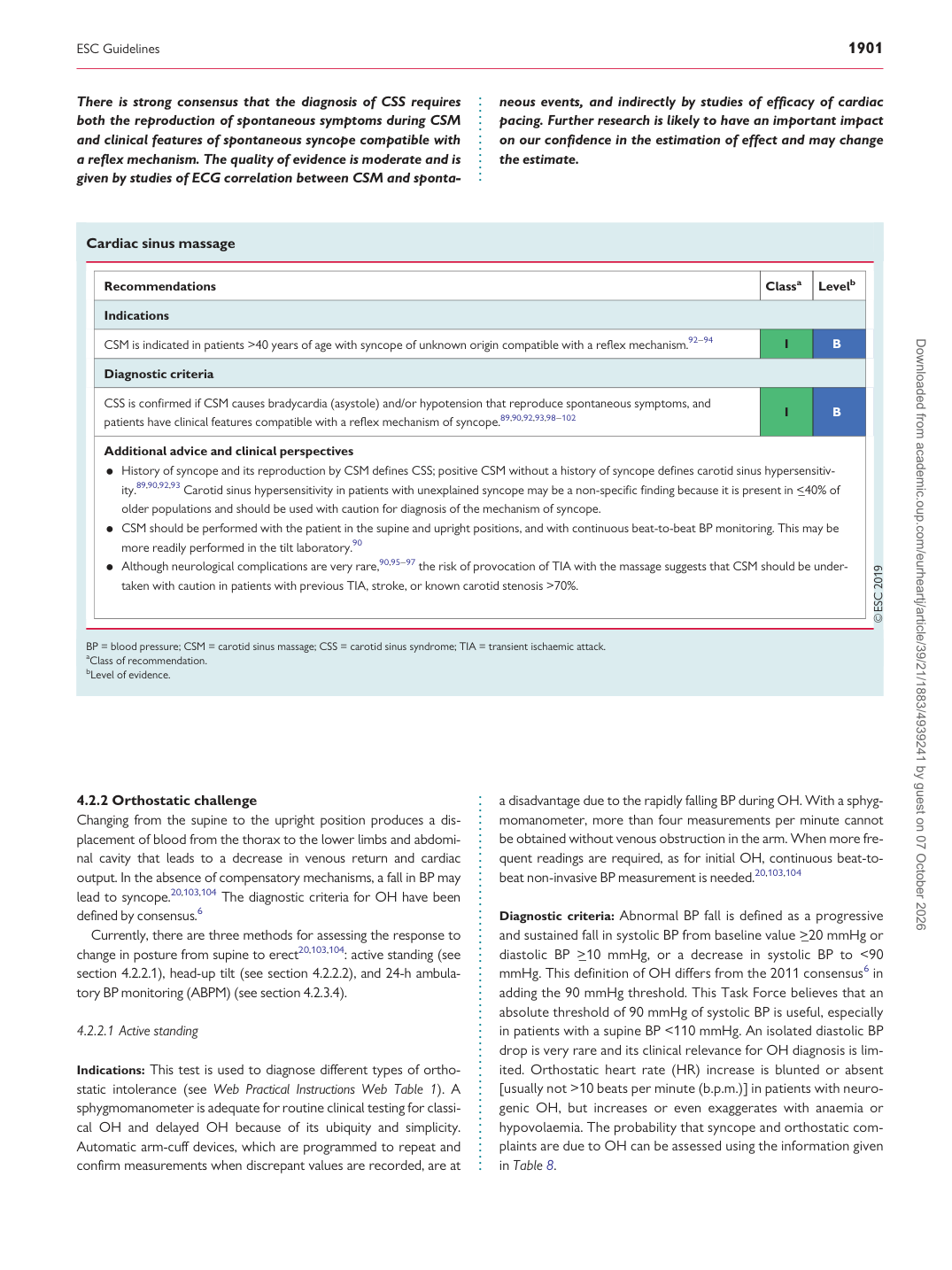
Cardiac sinus massage

Recommendations Classa Levelb

Indications CSM is indicated in patients >40 years of age with syncope of unknown origin compatible with a reflex mechanism.92–94 I B

Diagnostic criteria

CSS is confirmed if CSM causes bradycardia (asystole) and/or hypotension that reproduce spontaneous symptoms, and patients have clinical features compatible with a reflex mechanism of syncope.89,90,92,93,98–102 I B

Additional advice and clinical perspectives • History of syncope and its reproduction by CSM defines CSS; positive CSM without a history of syncope defines carotid sinus hypersensitivity.89,90,92,93 Carotid sinus hypersensitivity in patients with unexplained syncope may be a non-specific finding because it is present in <_40% of older populations and should be used with caution for diagnosis of the mechanism of syncope. • CSM should be performed with the patient in the supine and upright positions, and with continuous beat-to-beat BP monitoring. This may be more readily performed in the tilt laboratory.90 • Although neurological complications are very rare,90,95–97 the risk of provocation of TIA with the massage suggests that CSM should be under-

taken with caution in patients with previous TIA, stroke, or known carotid stenosis >70%.

BP = blood pressure; CSM = carotid sinus massage; CSS = carotid sinus syndrome; TIA = transient ischaemic attack. aClass of recommendation. bLevel of evidence. Downloaded from academic.oup.com/eurheartj/article/39/21/1883/4939241 by guest on 07 October 2026