p.18 抽出テキスト
........................................................................................ Data Table 3).26,34–36,44,88 None of these rules are used widely in EDs due to poor sensitivity and specificity reported from external validation, or due to a lack of external validation.70,78–85 Syncope clinical decision rules perform no better than clinician judgment at predicting short-term serious outcomes.86 Clinical decision rules can predict poor outcomes, but most syncope deaths and many poor outcomes are associated with underlying illness rather than syncope per se,58

particularly in the long term.56

Even if the quality of evidence is moderate, there is strong consensus from several studies that currently available risk stratification scores have not shown better sensitivity, specificity, or prognostic yield compared with clinical judgment in predicting short-term serious outcomes after syncope. Therefore, they should not be used alone to perform risk stratification in the ED.

4.2 Diagnostic tests

4.2.1 Carotid sinus massage A ventricular pause lasting >3 s and/or a fall in systolic BP of >50 mmHg is known as carotid sinus hypersensitivity. Carotid sinus hypersensitivity is a common finding in older men without syncope; abnormal responses are frequently observed (<_40%) in patients without syncope, especially if they are older and affected by cardiovascular disease.89 Carotid sinus hypersensitivity is exceptional in patients <40 years of age.90 The specificity of the test increases if spontaneous syncope is reproduced during CSM. Syncope was induced in only 5% of asymptomatic persons aged >65 years.89 For the above reasons, the diagnosis of carotid sinus syndrome (CSS) requires the reproduction of spontaneous symptoms and, in addition, that patients have syncope of unknown origin compatible with a reflex mechanism. In such circumstances, CSM usually shows a period of asystole >6 s.91 The prevalence of CSS, as defined here, was 8.8% when CSM was performed after the initial evaluation in 1855 consecutive patients >40 years of age with syncope compatible with a reflex mechanism.92,93 In a multicentre study94 aimed at validation of the 2009 ESC Guidelines, CSM was indicated after initial evaluation in 73% of 700 patients and was diagnostic in 12%. The precise methodology and results of CSM are shown in section 5 of the Web Practical Instructions.

The main complications of CSM are neurological. When pooling the data from four studies90,95–97 in which 8720 patients were analysed, TIAs or strokes were observed in 21 (0.24%). The relationship between abnormal response to CSM and spontaneous syncope is a crucial point that has been studied using two methods. The first was a pre-post comparison of the recurrence rate of syncope after pacing. Non-randomized studies demonstrated fewer recurrences at follow-up in paced patients than in those without pacing. These results were confirmed in two randomized trials.98,99 The second method was to analyse the occurrence of asystolic episodes registered in patients with a cardioinhibitory response to CSM using an implanted device. Recordings of long pauses were very common in the two trials that employed this method.100,101 These results suggest that a positive response to CSM, reproducing symptoms, in patients with syncope is highly predictive of the occurrence of spontaneous asystolic episodes.

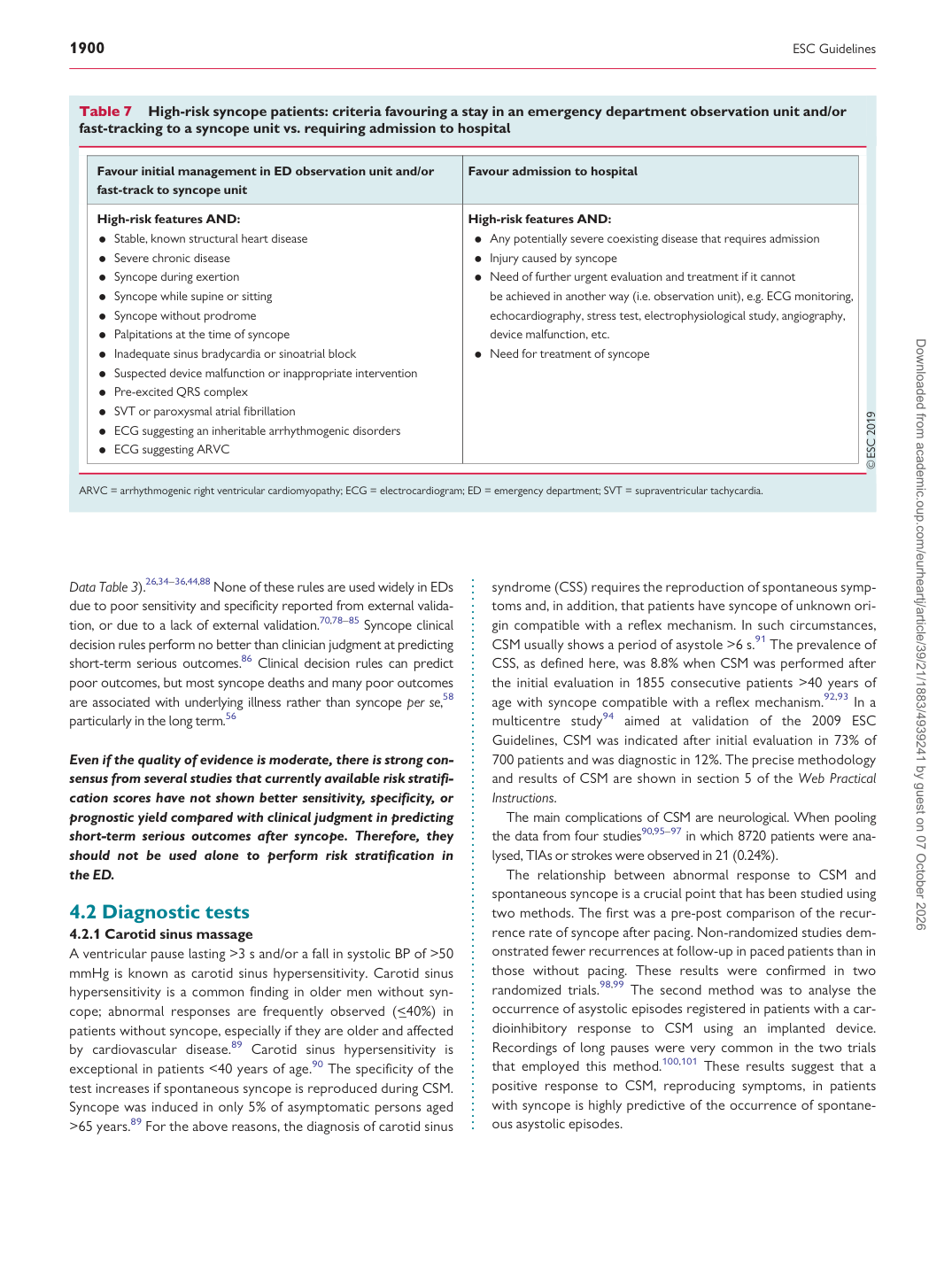
Table 7 High-risk syncope patients: criteria favouring a stay in an emergency department observation unit and/or fast-tracking to a syncope unit vs. requiring admission to hospital

Favour initial management in ED observation unit and/or fast-track to syncope unit Favour admission to hospital

High-risk features AND: • Stable, known structural heart disease • Severe chronic disease • Syncope during exertion • Syncope while supine or sitting • Syncope without prodrome • Palpitations at the time of syncope • Inadequate sinus bradycardia or sinoatrial block • Suspected device malfunction or inappropriate intervention • Pre-excited QRS complex • SVT or paroxysmal atrial fibrillation • ECG suggesting an inheritable arrhythmogenic disorders • ECG suggesting ARVC High-risk features AND:

• Any potentially severe coexisting disease that requires admission • Injury caused by syncope • Need of further urgent evaluation and treatment if it cannot

be achieved in another way (i.e. observation unit), e.g. ECG monitoring, echocardiography, stress test, electrophysiological study, angiography,

device malfunction, etc. • Need for treatment of syncope

ARVC = arrhythmogenic right ventricular cardiomyopathy; ECG = electrocardiogram; ED = emergency department; SVT = supraventricular tachycardia. Downloaded from academic.oup.com/eurheartj/article/39/21/1883/4939241 by guest on 07 October 2026