p.17 抽出テキスト
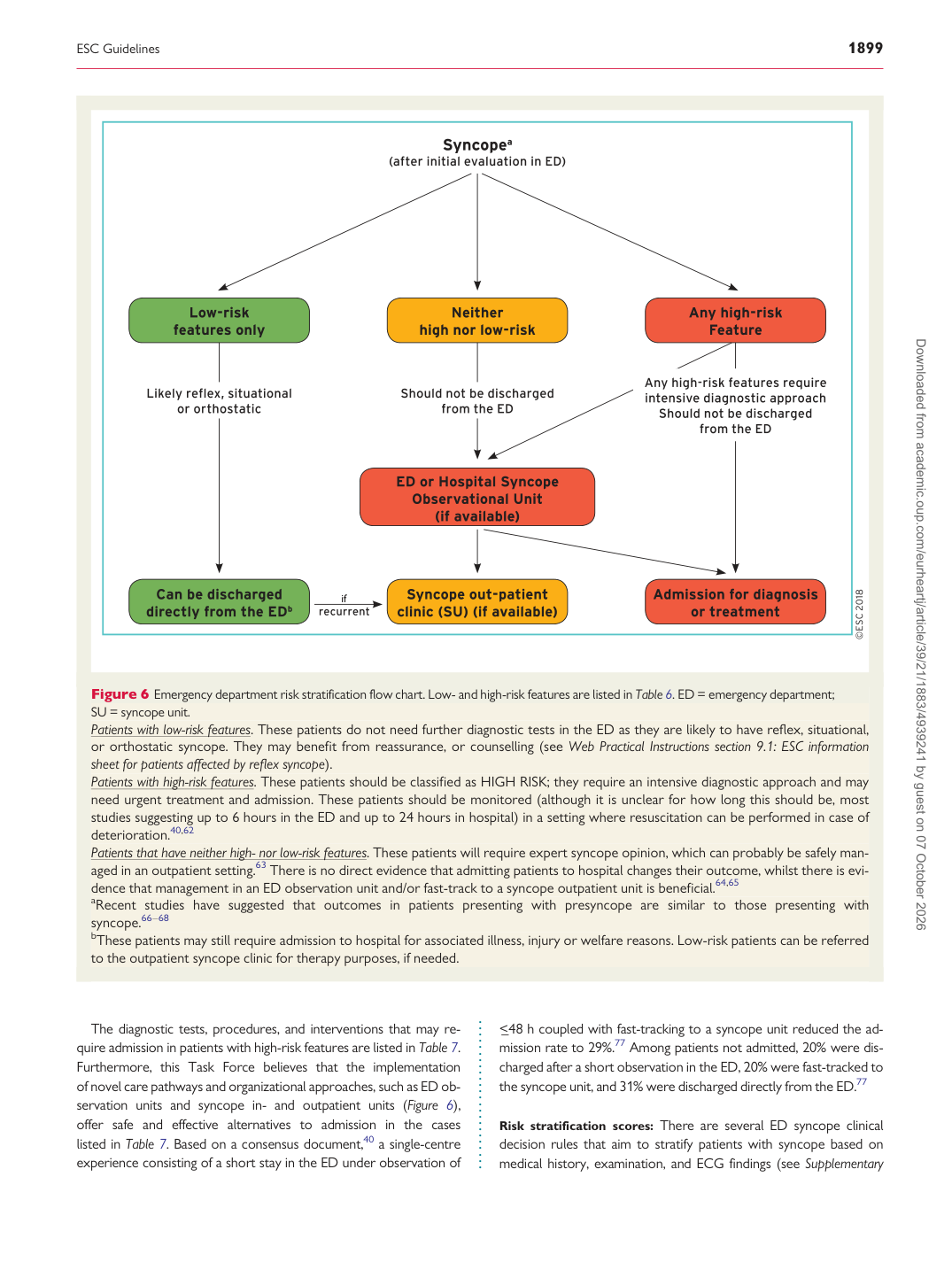
........................ The diagnostic tests, procedures, and interventions that may require admission in patients with high-risk features are listed in Table 7. Furthermore, this Task Force believes that the implementation of novel care pathways and organizational approaches, such as ED observation units and syncope in- and outpatient units (Figure 6), offer safe and effective alternatives to admission in the cases listed in Table 7. Based on a consensus document,40 a single-centre experience consisting of a short stay in the ED under observation of <_48 h coupled with fast-tracking to a syncope unit reduced the admission rate to 29%.77 Among patients not admitted, 20% were discharged after a short observation in the ED, 20% were fast-tracked to the syncope unit, and 31% were discharged directly from the ED.77

Risk stratification scores: There are several ED syncope clinical decision rules that aim to stratify patients with syncope based on medical history, examination, and ECG findings (see Supplementary

if

Figure 6 Emergency department risk stratification flow chart. Low- and high-risk features are listed in Table 6. ED = emergency department; SU = syncope unit. Patients with low-risk features. These patients do not need further diagnostic tests in the ED as they are likely to have reflex, situational, or orthostatic syncope. They may benefit from reassurance, or counselling (see Web Practical Instructions section 9.1: ESC information sheet for patients affected by reflex syncope). Patients with high-risk features. These patients should be classified as HIGH RISK; they require an intensive diagnostic approach and may need urgent treatment and admission. These patients should be monitored (although it is unclear for how long this should be, most studies suggesting up to 6 hours in the ED and up to 24 hours in hospital) in a setting where resuscitation can be performed in case of deterioration.40,62 Patients that have neither high- nor low-risk features. These patients will require expert syncope opinion, which can probably be safely managed in an outpatient setting.63 There is no direct evidence that admitting patients to hospital changes their outcome, whilst there is evidence that management in an ED observation unit and/or fast-track to a syncope outpatient unit is beneficial.64,65 aRecent studies have suggested that outcomes in patients presenting with presyncope are similar to those presenting with syncope.66–68 bThese patients may still require admission to hospital for associated illness, injury or welfare reasons. Low-risk patients can be referred to the outpatient syncope clinic for therapy purposes, if needed. Downloaded from academic.oup.com/eurheartj/article/39/21/1883/4939241 by guest on 07 October 2026