p.14 抽出テキスト
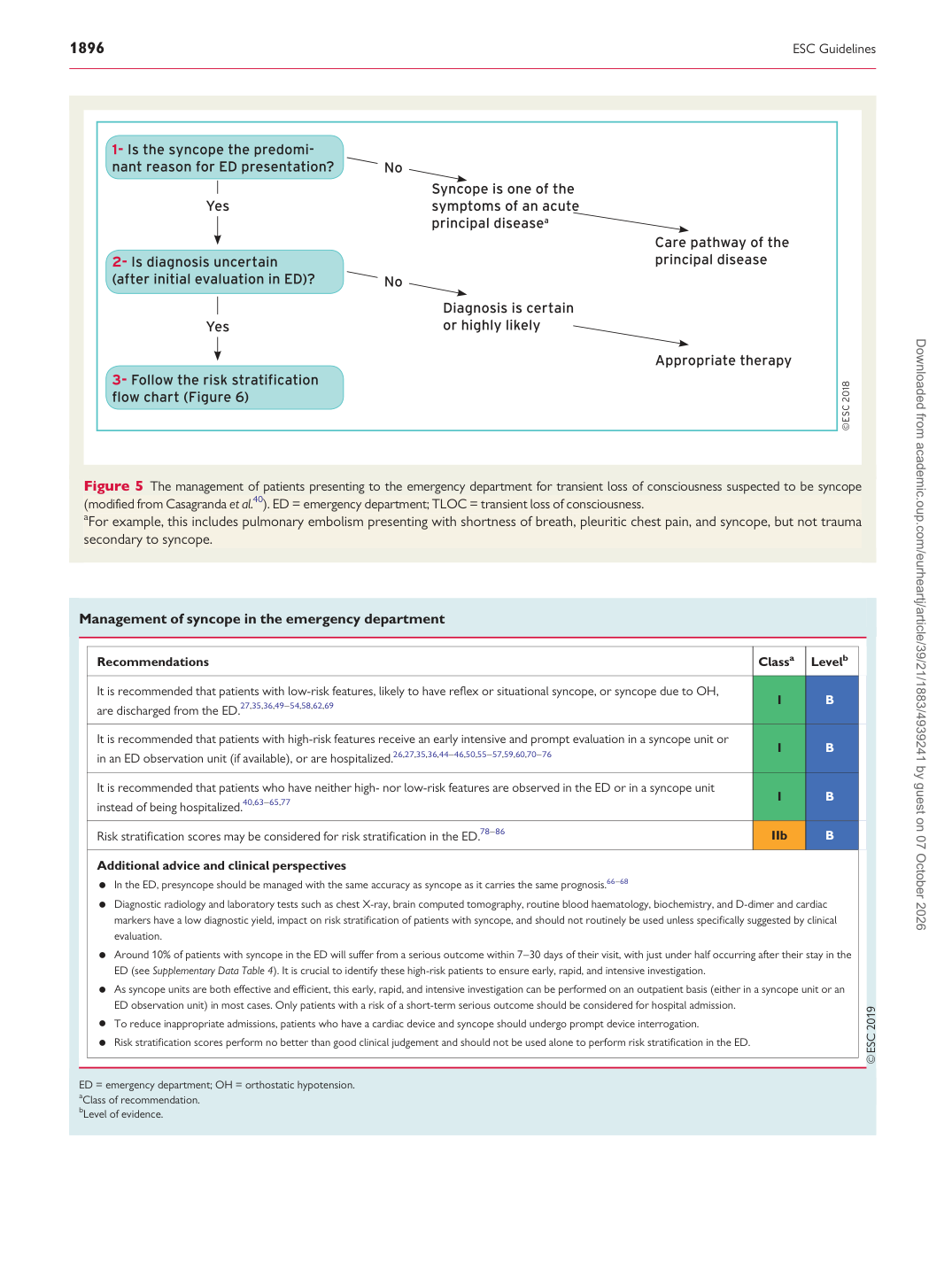
Figure 5 The management of patients presenting to the emergency department for transient loss of consciousness suspected to be syncope (modified from Casagranda et al.40). ED = emergency department; TLOC = transient loss of consciousness. aFor example, this includes pulmonary embolism presenting with shortness of breath, pleuritic chest pain, and syncope, but not trauma secondary to syncope.

Management of syncope in the emergency department

Recommendations Classa Levelb

It is recommended that patients with low-risk features, likely to have reflex or situational syncope, or syncope due to OH, are discharged from the ED.27,35,36,49–54,58,62,69 I B

It is recommended that patients with high-risk features receive an early intensive and prompt evaluation in a syncope unit or in an ED observation unit (if available), or are hospitalized.26,27,35,36,44–46,50,55–57,59,60,70–76 I B

It is recommended that patients who have neither high- nor low-risk features are observed in the ED or in a syncope unit instead of being hospitalized.40,63–65,77 I B Risk stratification scores may be considered for risk stratification in the ED.78–86 IIb B

Additional advice and clinical perspectives • In the ED, presyncope should be managed with the same accuracy as syncope as it carries the same prognosis.66–68 • Diagnostic radiology and laboratory tests such as chest X-ray, brain computed tomography, routine blood haematology, biochemistry, and D-dimer and cardiac markers have a low diagnostic yield, impact on risk stratification of patients with syncope, and should not routinely be used unless specifically suggested by clinical evaluation. • Around 10% of patients with syncope in the ED will suffer from a serious outcome within 7–30 days of their visit, with just under half occurring after their stay in the ED (see Supplementary Data Table 4). It is crucial to identify these high-risk patients to ensure early, rapid, and intensive investigation. • As syncope units are both effective and efficient, this early, rapid, and intensive investigation can be performed on an outpatient basis (either in a syncope unit or an ED observation unit) in most cases. Only patients with a risk of a short-term serious outcome should be considered for hospital admission. • To reduce inappropriate admissions, patients who have a cardiac device and syncope should undergo prompt device interrogation. • Risk stratification scores perform no better than good clinical judgement and should not be used alone to perform risk stratification in the ED.

ED = emergency department; OH = orthostatic hypotension. aClass of recommendation. bLevel of evidence. Downloaded from academic.oup.com/eurheartj/article/39/21/1883/4939241 by guest on 07 October 2026