p.10 抽出テキスト
.................

tonic-clonic, and atonic generalized seizures, and can be classified as primary or secondary. The forms of epilepsy in which people remain actively upright, i.e. sitting or standing (e.g. complex partial seizures or absence epilepsy) are not regarded as TLOC, but sometimes they are incorrectly diagnosed as syncope. Psychogenic TLOC consists of two forms: one resembles epileptic seizures (psychogenic non-epileptic seizures [PNES]) and one, without gross movements, resembles syncope (psychogenic pseudosyncope [PPS]). The rare causes of TLOC only seldomly cause confusion with the main TLOC forms, probably because in most cases they differ enough clinically to be clearly not syncope. Both vertebrobasilar transient ischaemic attacks (TIAs) and subclavian steal syndrome are associated with focal neurological signs. A subarachnoid haemorrhage may present with a short LOC, but the associated abrupt extreme headache suggests the cause. In cyanotic breath-holding spells, expiratory apnoea with hypoxia is the primary mechanism.10 Socalled ‘pallid breath-holding spells’ in children do not constitute a primary respiratory problem, but are cardioinhibitory reflex syncope.11 Table 4 lists the main features that distinguish syncope from disorders that may be mistaken for syncope.

4 Diagnostic evaluation and

management according to risk stratification

4.1 Initial evaluation

The clinical features characterizing TLOC are usually derived from history taking from patients and eyewitnesses. When a patient first presents with possible TLOC, history taking should first establish whether there was indeed a TLOC. Often, this allows a distinction between the major TLOC groups. The flow diagram for the evaluation of TLOC is shown in Figure 4. The initial evaluation should answer key questions:

(1) Was the event TLOC?

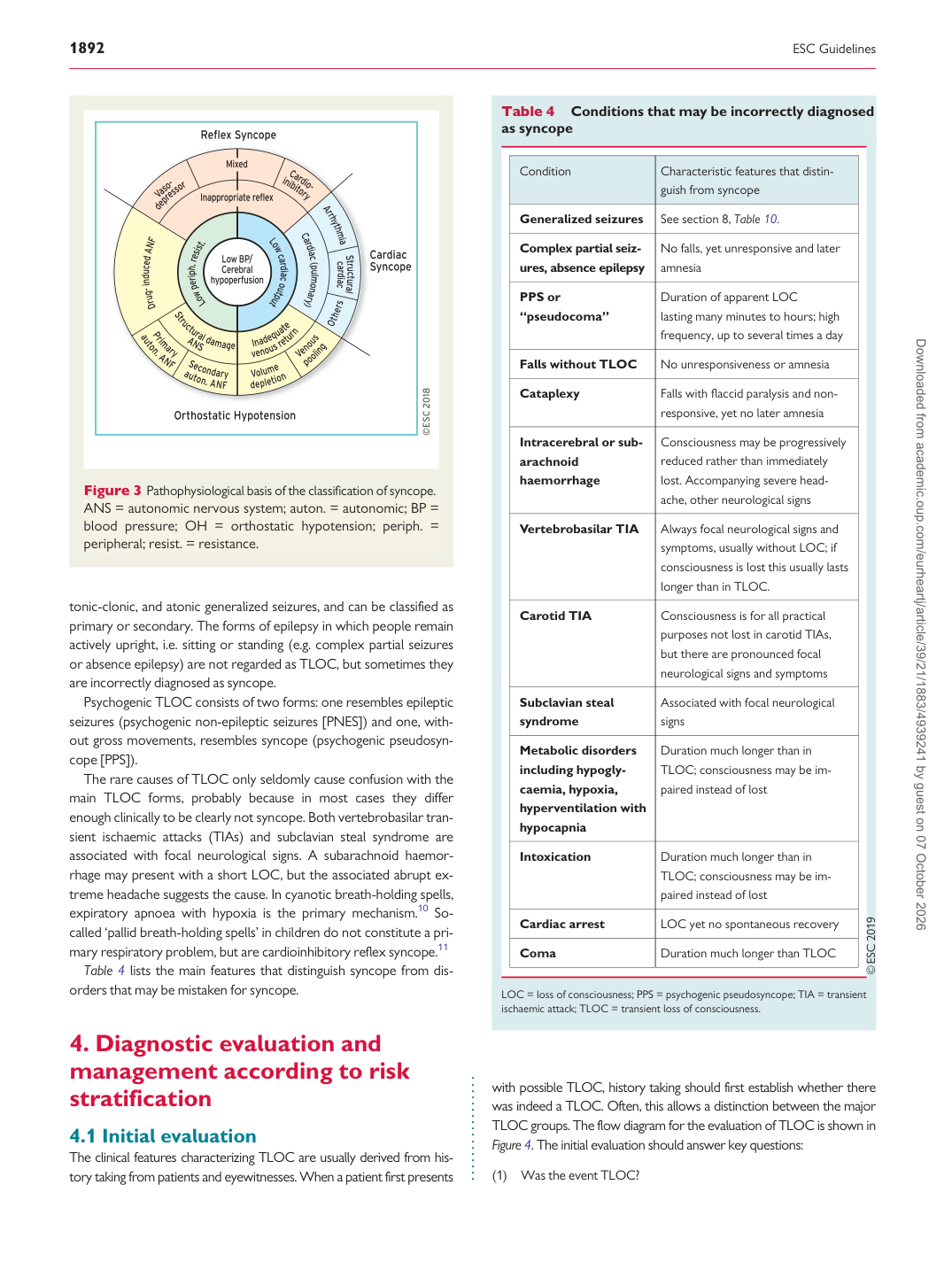
Figure 3 Pathophysiological basis of the classification of syncope. ANS = autonomic nervous system; auton. = autonomic; BP = blood pressure; OH = orthostatic hypotension; periph. = peripheral; resist. = resistance. Table 4 Conditions that may be incorrectly diagnosed as syncope

Condition Characteristic features that distinguish from syncope

Generalized seizures See section 8, Table 10.

Complex partial seizures, absence epilepsy No falls, yet unresponsive and later

amnesia

PPS or “pseudocoma” Duration of apparent LOC lasting many minutes to hours; high

frequency, up to several times a day

Falls without TLOC No unresponsiveness or amnesia

Cataplexy Falls with flaccid paralysis and nonresponsive, yet no later amnesia

Intracerebral or subarachnoid haemorrhage Consciousness may be progressively

reduced rather than immediately lost. Accompanying severe headache, other neurological signs

Vertebrobasilar TIA Always focal neurological signs and

symptoms, usually without LOC; if consciousness is lost this usually lasts longer than in TLOC.

Carotid TIA Consciousness is for all practical

purposes not lost in carotid TIAs, but there are pronounced focal neurological signs and symptoms

Subclavian steal syndrome Associated with focal neurological

signs

Metabolic disorders including hypoglycaemia, hypoxia, hyperventilation with hypocapnia Duration much longer than in TLOC; consciousness may be im-

paired instead of lost

Intoxication Duration much longer than in

TLOC; consciousness may be impaired instead of lost

Cardiac arrest LOC yet no spontaneous recovery

Coma Duration much longer than TLOC

LOC = loss of consciousness; PPS = psychogenic pseudosyncope; TIA = transient ischaemic attack; TLOC = transient loss of consciousness. Downloaded from academic.oup.com/eurheartj/article/39/21/1883/4939241 by guest on 07 October 2026