p.9 抽出テキスト
.......................................... 3. General considerations

3.1 Epidemiology

In the western world, the risk of CVD in pregnancy has increased due to increasing age at first pregnancy. According to World Atlas,27 the 10 countries where mean age at first birth is highest record a mean age between 28.8–31.2 years. The mild increase in maternal age does not justify an increase in CVD during pregnancy because of maternal age. However, pregnancies in the late reproductive years (or between ages of 40–50 years) are more frequently associated with an increasing prevalence of cardiovascular risk factors, especially diabetes, hypertension, and obesity. Additionally, an increasing number of women with congenital heart disease reach childbearing age.5 In western countries, maternal heart disease is the major cause of maternal death during pregnancy.2,28 The current background information and detailed discussion of the data for the following section of these Guidelines can be found in ESC CardioMed 53.1a General considerations, 53.1b Pregnancy risk assessment and 53.2 Gynaecological, obstetric, and neonatological aspects.

Hypertensive disorders are the most frequent cardiovascular disorders during pregnancy, occurring in 5–10% of all pregnancies (see section 10). Among the other disease conditions, congenital heart disease is the most frequent CVD present during pregnancy in the western world (75–82%).29,30 Rheumatic valvular disease dominates in nonwestern countries, comprising 56–89% of all CVDs in pregnancy.29,31 Peripartum intensive care unit (ICU) admissions are increasing in frequency, with affected women-who suffer from serious preexisting conditions, are older, and present with multiple

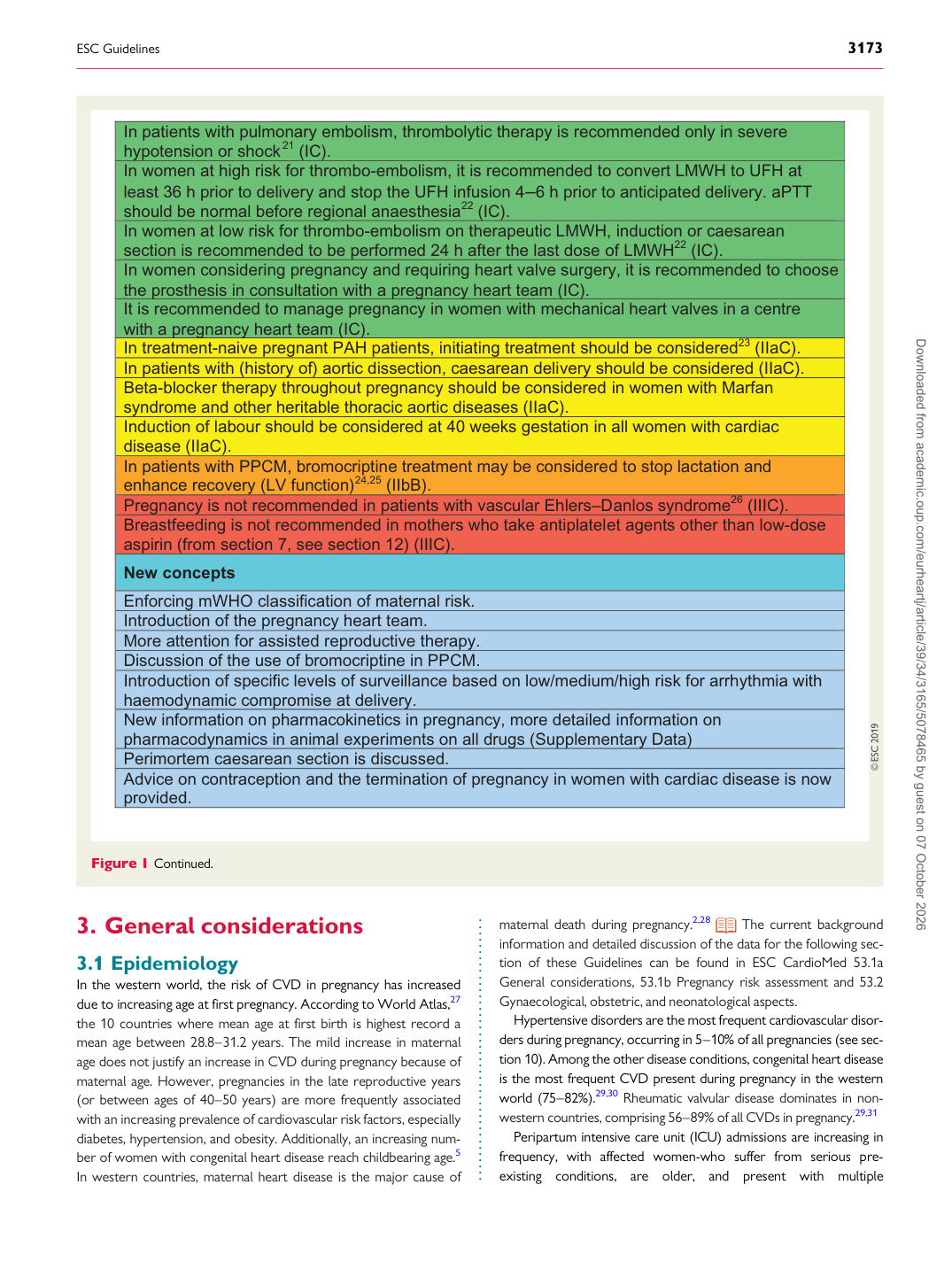
In patients with pulmonary embolism, thrombolytic therapy is recommended only in severe hypotension or shock 21 (IC). In women at high risk for thrombo-embolism, it is recommended to convert LMWH to UFH at least 36 h prior to delivery and stop the UFH infusion 4–6 h prior to anticipated delivery. aPTT should be normal before regional anaesthesia22 (IC). In women at low risk for thrombo-embolism on therapeutic LMWH, induction or caesarean section is recommended to be performed 24 h after the last dose of LMWH22 (IC).

In treatment-naive pregnant PAH patients, initiating treatment should be considered23 (IIaC). In patients with (history of) aortic dissection, caesarean delivery should be considered (IIaC). Beta-blocker therapy throughout pregnancy should be considered in women with Marfan syndrome and other heritable thoracic aortic diseases (IIaC). Induction of labour should be considered at 40 weeks gestation in all women with cardiac disease (IIaC). In patients with PPCM, bromocriptine treatment may be considered to stop lactation and enhance recovery (LV function)24,25 (IIbB). Pregnancy is not recommended in patients with vascular Ehlers–Danlos syndrome26 (IIIC). Breastfeeding is not recommended in mothers who take antiplatelet agents other than low-dose aspirin (from section 7, see section 12) (IIIC). New concepts Enforcing mWHO classification of maternal risk. Introduction of the pregnancy heart team. More attention for assisted reproductive therapy. Discussion of the use of bromocriptine in PPCM. Introduction of specific levels of surveillance based on low/medium/high risk for arrhythmia with haemodynamic compromise at delivery. New information on pharmacokinetics in pregnancy, more detailed information on pharmacodynamics in animal experiments on all drugs (Supplementary Data) Perimortem caesarean section is discussed. Advice on contraception and the termination of pregnancy in women with cardiac disease is now provided.

In women considering pregnancy and requiring heart valve surgery, it is recommended to choose the prosthesis in consultation with a pregnancy heart team (IC). It is recommended to manage pregnancy in women with mechanical heart valves in a centre with a pregnancy heart team (IC).

Figure 1 Continued. Downloaded from academic.oup.com/eurheartj/article/39/34/3165/5078465 by guest on 07 October 2026