p.7 抽出テキスト
..............................................................................................................................................

not override in any way whatsoever the individual responsibility of health professionals to make appropriate and accurate decisions in consideration of each patient’s health condition and in consultation with that patient or the patient’s caregiver where appropriate and/or necessary. It is also the health professional’s responsibility to verify the rules and regulations applicable to drugs and devices at the time of prescription.

2 Introduction

2.1 Why do we need new Guidelines on

the management of cardiovascular diseases in pregnancy? Since the previous version of these Guidelines was published in 2012, new evidence has accumulated, particularly on diagnostic techniques, risk assessment, and the use of cardiovascular drugs. This made a revision of the recommendations necessary.

2.2 New format of the Guidelines

The new Guidelines have been adapted to facilitate their use in clinical practice and to meet readers’ demands by focusing on condensed, clearly presented recommendations. At the end of each section, ‘recommendations’ summarize the essentials. ‘Gaps in the evidence’ are listed in section 13 to propose topics for future research. The Guidelines document is harmonized with the simultaneously published chapter on the management of cardiovascular diseases (CVDs) in pregnancy of the ESC Textbook of Cardiology (http://oxfordmedi cine.com/view/10.1093/med/9780199566990.001.0001/med-978019 9566990-chapter-33). Background information and a detailed discussion of the data that have provided the basis for the recommendations can be found in the relevant book chapter.

2.3 Why these Guidelines are important

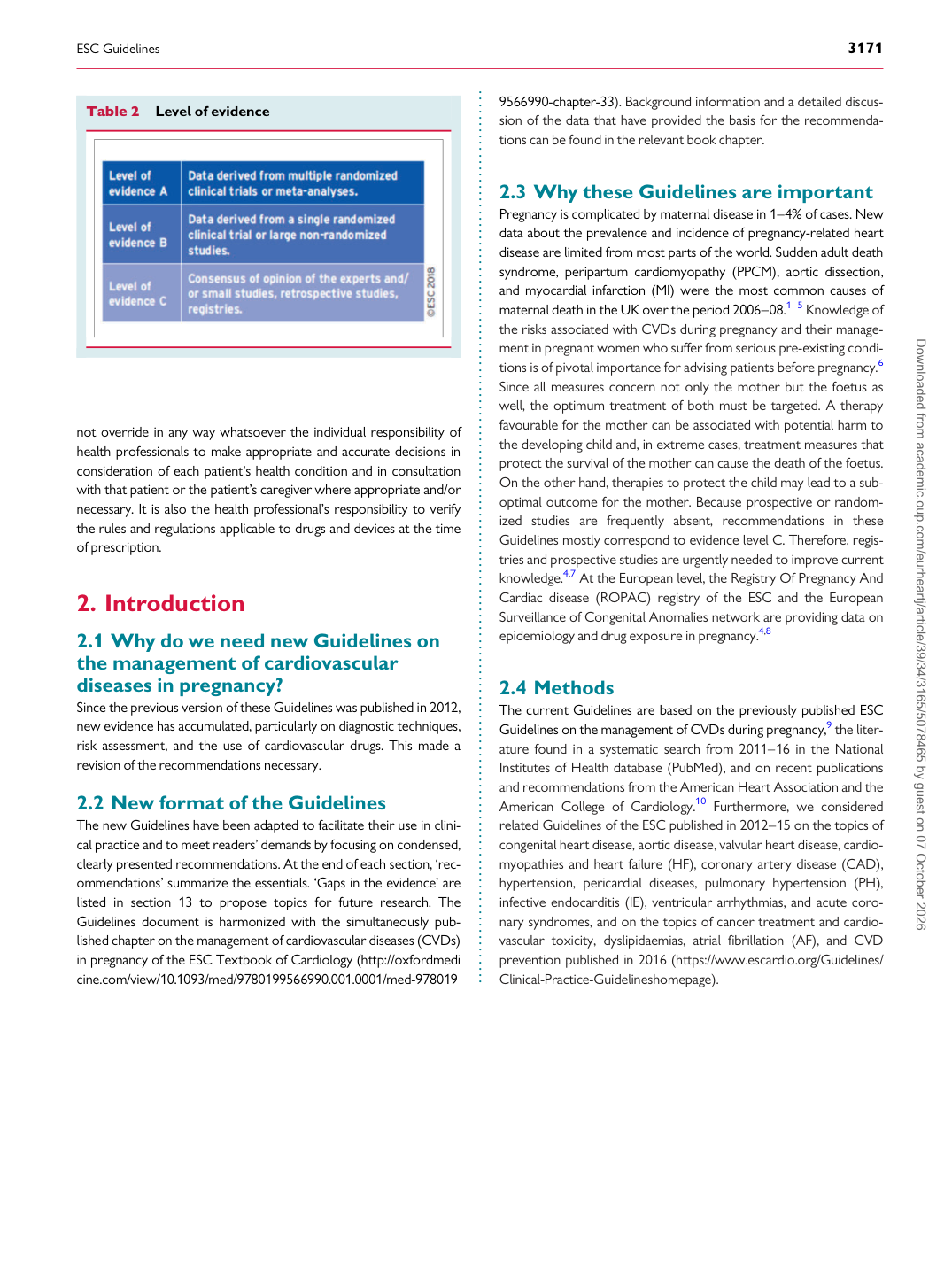
Pregnancy is complicated by maternal disease in 1–4% of cases. New data about the prevalence and incidence of pregnancy-related heart disease are limited from most parts of the world. Sudden adult death syndrome, peripartum cardiomyopathy (PPCM), aortic dissection, and myocardial infarction (MI) were the most common causes of maternal death in the UK over the period 2006–08.1–5 Knowledge of the risks associated with CVDs during pregnancy and their management in pregnant women who suffer from serious pre-existing conditions is of pivotal importance for advising patients before pregnancy.6 Since all measures concern not only the mother but the foetus as well, the optimum treatment of both must be targeted. A therapy favourable for the mother can be associated with potential harm to the developing child and, in extreme cases, treatment measures that protect the survival of the mother can cause the death of the foetus. On the other hand, therapies to protect the child may lead to a suboptimal outcome for the mother. Because prospective or randomized studies are frequently absent, recommendations in these Guidelines mostly correspond to evidence level C. Therefore, registries and prospective studies are urgently needed to improve current knowledge.4,7 At the European level, the Registry Of Pregnancy And Cardiac disease (ROPAC) registry of the ESC and the European Surveillance of Congenital Anomalies network are providing data on epidemiology and drug exposure in pregnancy.4,8

2.4 Methods

The current Guidelines are based on the previously published ESC Guidelines on the management of CVDs during pregnancy,9 the literature found in a systematic search from 2011–16 in the National Institutes of Health database (PubMed), and on recent publications and recommendations from the American Heart Association and the American College of Cardiology.10 Furthermore, we considered related Guidelines of the ESC published in 2012–15 on the topics of congenital heart disease, aortic disease, valvular heart disease, cardiomyopathies and heart failure (HF), coronary artery disease (CAD), hypertension, pericardial diseases, pulmonary hypertension (PH), infective endocarditis (IE), ventricular arrhythmias, and acute coronary syndromes, and on the topics of cancer treatment and cardiovascular toxicity, dyslipidaemias, atrial fibrillation (AF), and CVD prevention published in 2016 (https://www.escardio.org/Guidelines/ Clinical-Practice-Guidelineshomepage).

Table 2 Level of evidence

Downloaded from academic.oup.com/eurheartj/article/39/34/3165/5078465 by guest on 07 October 2026