p.50 抽出テキスト
.................................................................................................. Spironolactone is not advised in humans during pregnancy.36

Eplerenone has been associated with post-implantation losses at the highest administered doses in rabbits, and should only be used in pregnancy if clearly needed.

12.1.2.6 Calcium channel blockers CCBs do not seem to be associated with an increased incidence of congenital anomalies in humans.36 In one study with 721 pregnancies exposed to CCBs during the third trimester, an increased risk (relative risk 3.6, 95% CI 1.3–10.4) of neonatal seizures with CCBs was reported.36,429 Diltiazem is teratogenic in animals and only limited data in humans exist; thus, its use is only recommended in pregnancy if the potential benefit justifies the potential risk to the foetus.36 Verapamil is considered to be fairly safe during pregnancy, and is recommended as a second-line drug for rate control in AF and for the treatment of idiopathic sustained VTs in pregnant women.36

12.1.2.7 Statins Statins should not be prescribed in pregnancy or during breastfeeding to treat hyperlipidaemia since their harmlessness is not proven. However, in a review published in 2012, no evidence of teratogenicity of statins was found, but a harmful effect could not be ruled out due to small sample sizes.36,430 In a prospective case-control study of 249 foetuses exposed to statins, the rate of birth defects did not differ significantly between cases and controls.36,431

12.2 US Food and Drug Administration

classification On 30 June 2015, the US Food and Drug Administration (FDA) changed the previously used classification system for the counselling of pregnant women and nursing mothers requiring drug therapy.432 The former A to X categories have been replaced by the Pregnancy and Lactation Labelling Rule (PLLR), which provides a descriptive risk summary and detailed information on animal and clinical data. PLLR applies immediately for prescription drugs approved after 30 June 2015, and the former FDA categories have to be removed for all other drugs until 29 June 2018. However, the former FDA categories will be present in the literature for a longer period of time, therefore Table 7 provides information on both systems. For detailed up-todate information on drugs used during pregnancy and breast feeding, please see the Supplementary Data/Web version of the guidelines. Detailed information can also be found on www.ema.europa.eu/, www.accessdata.fda.gov, http://www.embryotox.de, or from prescription labels provided by manufacturers. The previous classification consisted of category A (safest) to X (known danger: do not use!). The following categories were used for drugs during pregnancy and breastfeeding, as outlined in the 2011 Guidelines.9 Category A: adequate and well-controlled studies have failed to demonstrate a foetal risk in the first trimester (and there is no evidence of risk in the later trimesters). Category B: either animal reproduction studies have not demonstrated a foetal risk but there are no controlled studies in pregnant women, or animal reproduction studies have shown an adverse effect that was not confirmed in controlled studies in women. Category C: either studies in animals have revealed adverse effects on the foetus and there are no controlled studies in women, or studies in women and animals are not available. Drugs should be given only if potential benefits justify the potential risk to the foetus.

Category D: there is evidence of human foetal risk, but the benefits from use in a pregnant woman may be acceptable despite the risk (e.g. treatment of life-threatening conditions). Category X: studies in animals or humans have demonstrated foetal abnormalities, there is evidence of foetal risk based on human experience, or both, and the risk of drug use in pregnant women clearly outweighs any possible benefit. The drug is contraindicated in women who are or may become pregnant.

12.3 Internet databases

The authors of the database www.embryotox.de of the Pharmakovigilanz- und Beratungszentrum fu ̈r Embryonaltoxikologie of the Berliner Betrieb fu ̈r Zentrale Gesundheitliche Aufgabe base their recommendations on a combination of scientific sources, expert opinion that is mainly based on observational data, and personal experiences of women during pregnancy and breastfeeding. The English database www.safefetus.com is arranged in a similar fashion to the German database.

12.4 Pharmaceutical industry

Manufacturers’ instructions are mainly based on the fact that drugs are not tested sufficiently during pregnancy and breastfeeding. For this and for legal reasons, drugs are frequently considered prohibited during pregnancy and breastfeeding.

12.5 Recommendations

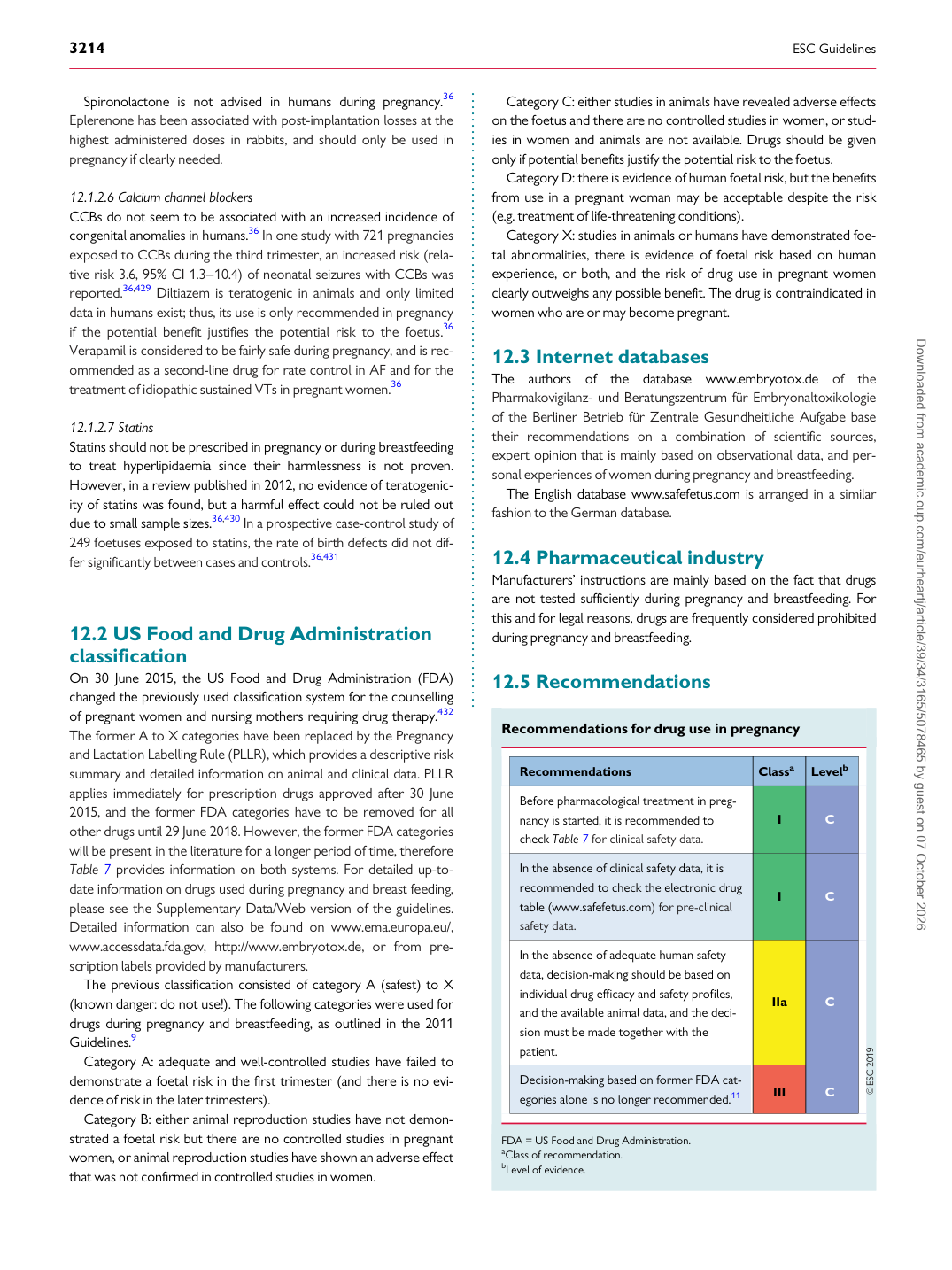
Recommendations for drug use in pregnancy

Recommendations Classa Levelb

Before pharmacological treatment in pregnancy is started, it is recommended to check Table 7 for clinical safety data. I C

In the absence of clinical safety data, it is recommended to check the electronic drug table (www.safefetus.com) for pre-clinical safety data. I C

In the absence of adequate human safety data, decision-making should be based on individual drug efficacy and safety profiles, and the available animal data, and the decision must be made together with the patient. IIa C

Decision-making based on former FDA categories alone is no longer recommended.11 III C

FDA = US Food and Drug Administration. aClass of recommendation. bLevel of evidence. Downloaded from academic.oup.com/eurheartj/article/39/34/3165/5078465 by guest on 07 October 2026