p.45 抽出テキスト
.............................................................. 10.6 Prognosis after pregnancy 10.6.1 Blood pressure post-partum Post-partum hypertension is common in the first week. Methyldopa should be avoided because of the risk of post-partum depression.384

10.6.2 Hypertension and lactation Breastfeeding does not increase BP in the nursing mother. Cabergoline, rather than bromocriptine, is recommended for lactation suppression. However, there is some evidence that bromocriptine might be beneficial in PPCM,264 although it may induce hypertension. All antihypertensive agents taken by the nursing mother are excreted into breast milk.385 Most of the antihypertensive drugs are present at very low concentrations, except for propranolol and nifedipine, which have breast milk concentrations similar to those in maternal plasma.

10.6.3 Risk of recurrence of hypertensive disorders in a subsequent pregnancy Women experiencing hypertension in their first pregnancy are at increased risk in a subsequent pregnancy. The earlier the onset of hypertension in the first pregnancy, the higher the risk of recurrence in a subsequent pregnancy.

10.6.4 Long-term cardiovascular consequences of gestational hypertension Women who develop gestational hypertension or pre-eclampsia are at increased risk of hypertension, stroke, and ischaemic heart disease in later adult life.386,387 Lifestyle modifications are primarily indicated to avoid complications in subsequent pregnancies and to reduce maternal cardiovascular risk in the future. Therefore, annual visits to a primary care physician to check BP and metabolic factors are recommended.

10.6.5 Fertility treatment There is no clear evidence that fertility treatment increases the risk of hypertension or pre-eclampsia.388

10.7 Recommendations

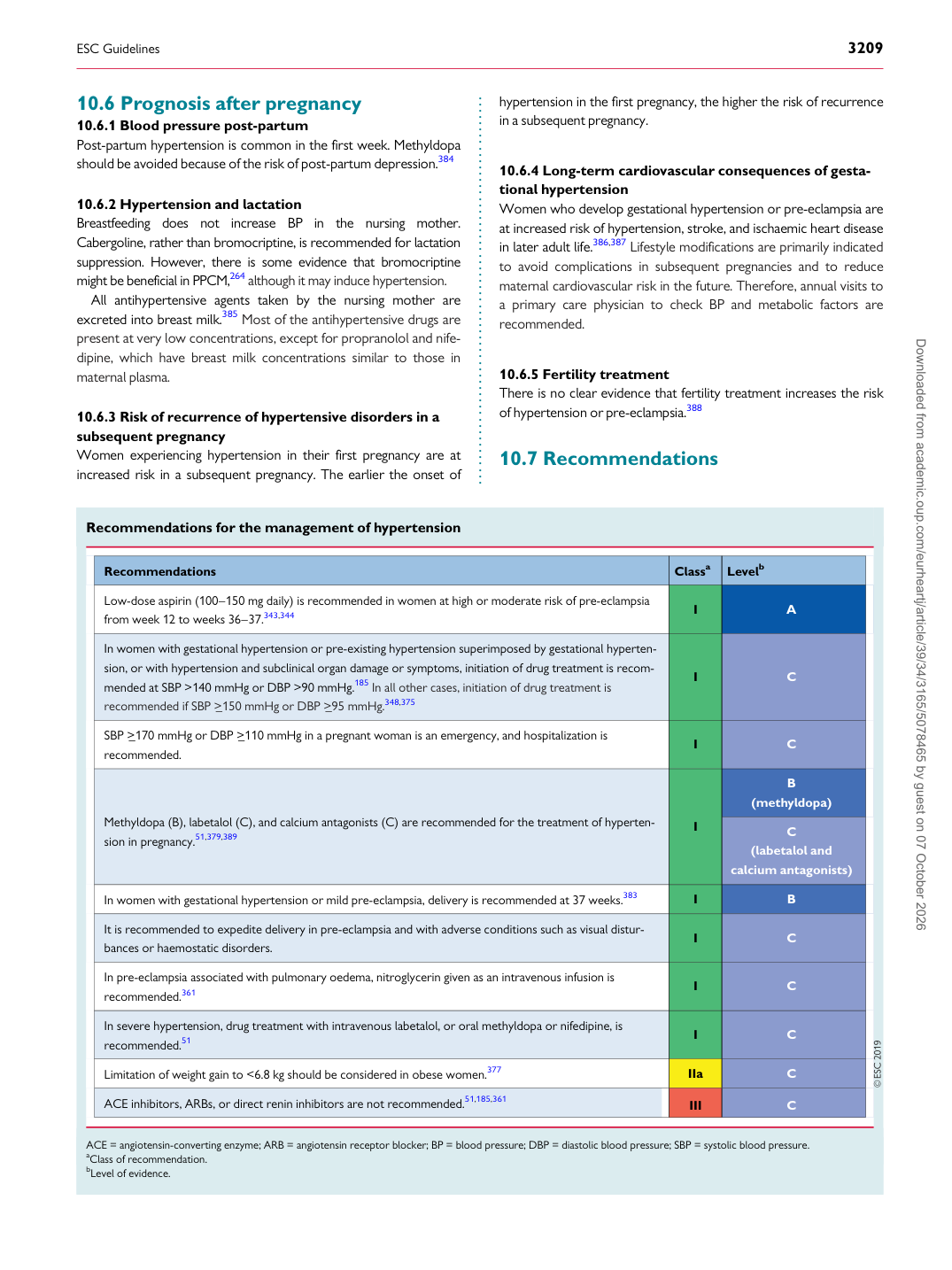
Recommendations for the management of hypertension

Recommendations Classa Levelb

Low-dose aspirin (100–150 mg daily) is recommended in women at high or moderate risk of pre-eclampsia from week 12 to weeks 36–37.343,344 I A

In women with gestational hypertension or pre-existing hypertension superimposed by gestational hypertension, or with hypertension and subclinical organ damage or symptoms, initiation of drug treatment is recommended at SBP >140 mmHg or DBP >90 mmHg.185 In all other cases, initiation of drug treatment is recommended if SBP >_150 mmHg or DBP >_95 mmHg.348,375 I C

SBP >_170 mmHg or DBP >_110 mmHg in a pregnant woman is an emergency, and hospitalization is recommended. I C

Methyldopa (B), labetalol (C), and calcium antagonists (C) are recommended for the treatment of hypertension in pregnancy.51,379,389 I B (methyldopa)

C (labetalol and calcium antagonists)

In women with gestational hypertension or mild pre-eclampsia, delivery is recommended at 37 weeks.383 I B

It is recommended to expedite delivery in pre-eclampsia and with adverse conditions such as visual disturbances or haemostatic disorders. I C

In pre-eclampsia associated with pulmonary oedema, nitroglycerin given as an intravenous infusion is recommended.361 I C

In severe hypertension, drug treatment with intravenous labetalol, or oral methyldopa or nifedipine, is recommended.51 I C Limitation of weight gain to <6.8 kg should be considered in obese women.377 IIa C ACE inhibitors, ARBs, or direct renin inhibitors are not recommended.51,185,361 III C

ACE = angiotensin-converting enzyme; ARB = angiotensin receptor blocker; BP = blood pressure; DBP = diastolic blood pressure; SBP = systolic blood pressure. aClass of recommendation. bLevel of evidence. Downloaded from academic.oup.com/eurheartj/article/39/34/3165/5078465 by guest on 07 October 2026