p.34 抽出テキスト
............................................................................................................................................................................. 7.6 Pre-existing CAD Women with pre-established CAD or ACS/MI are at risk of serious adverse cardiac events during pregnancy, the highest risk of which is seen in atherosclerotic coronary disease260 with reported maternal mortality between 0–23%.92,261,262 Adverse obstetric outcomes occur in <_16%, with 30% of pregnancies complicated by an adverse foetal/neonatal event, most commonly in coronary atherosclerosis (50%).260

Pregnancy may be considered in patients with known CAD in the absence of residual ischaemia and clinical signs of LV dysfunction. There are no high-quality data defining how long pregnancy should be delayed post-AMI/ACS. However, recommending 12 months seems reasonable, individualized according to comorbidities, cardiovascular status, and the requirement for medical therapy. There is no definitive evidence that previous P-SCAD increases recurrence risk. However, avoidance of further pregnancy is advised258 and, if the patient chooses to proceed, close monitoring is recommended.

7.7 Labour and delivery

Timing of delivery must be individualized. However, treatment of STEMI/NSTEMI should not be delayed for delivery. Delivery should be postponed (if possible) for at least 2 weeks post-AMI to facilitate maternal management.237 Vaginal delivery is preferable (see section 3).

7.8 Recommendations 8 Cardiomyopathies and heart

failure

The aetiology of pregnancy-associated cardiomyopathy includes acquired and inherited diseases, such PPCM, toxic cardiomyopathies, HCM, dilated cardiomyopathy (DCM), Takotsubo cardiomyopathy, and storage diseases. Although rare, they may cause severe complications in pregnancy.263 HF with preserved EF, an important cause of HF in older patients, does not appear to be a major clinical problem in pregnancy; however, it may be underdiagnosed. The current background information and detailed discussion of the data for the following section of these Guidelines can be found in ESC CardioMed.

8.1 Peripartum cardiomyopathy

PPCM has recently been reviewed32,263,264 and the EURObservational Research Programme international PPCM registry will provide fundamental data on this condition.265,266 Important predisposing factors include multiparity, African ethnicity, smoking, diabetes, pre-eclampsia, malnutrition, advanced age, and teenage pregnancy.32,263 The cause is uncertain, but potential aetiologies include inflammation and angiogenic imbalance, inducing vascular damage.267–270 The biologically active 16 kDa prolactin and other factors, such as soluble fms-like tyrosine kinase 1 (sFlt1), may initiate and drive PPCM.268,271,272

8.1.1 Diagnosis PPCM presents with HF secondary to LV systolic dysfunction towards the end of pregnancy and in the months following delivery, with the majority diagnosed post-partum. Careful history taking is necessary to identify and exclude other causes of HF.273–276 The LV may be non-dilated, but the EF is usually <45%.32,263,270 Symptoms and signs are often typical for HF with numerous phenotypes reported. Patients frequently present with acute HF, but also with ventricular arrhythmias and/or cardiac arrest.277–280 Echocardiography is the imaging modality of choice. Initial LVEF <30%, marked LV dilatation (LV end-diastolic diameter >_6.0 cm), and RV involvement are associated with adverse outcomes.278,281,282

8.1.2 Prognosis and counselling Prospective larger cohort studies have mainly focused on 6 month outcomes, reporting a mortality ranging from 2.0% in Germany277 to 12.6% in a large cohort of 206 patients with PPCM from South Africa.283 A prospective study over 24 months from Turkey reported a 24% mortality.284 When the EF has not recovered to >50–55%, subsequent pregnancy should be discouraged. Even with normalized EF, counselling is required due to potential recurrence. With expert interdisciplinary management and immediate bromocriptine treatment post-delivery, successful subsequent pregnancies, especially in patients with recovered EF, have been reported.285

8.2 Dilated cardiomyopathy

DCM encompasses a number of conditions resulting in LV dilatation and dysfunction including prior viral infection, drugs, and ischaemia. Some 50% of cases are idiopathic, of which 20–35% are hereditary.276 Around 40% of the genetic causes of DCM have been identified, with >50 gene mutations described.286 The prevalence of idiopathic DCM is 1:2500; however, this is likely an underestimate.287

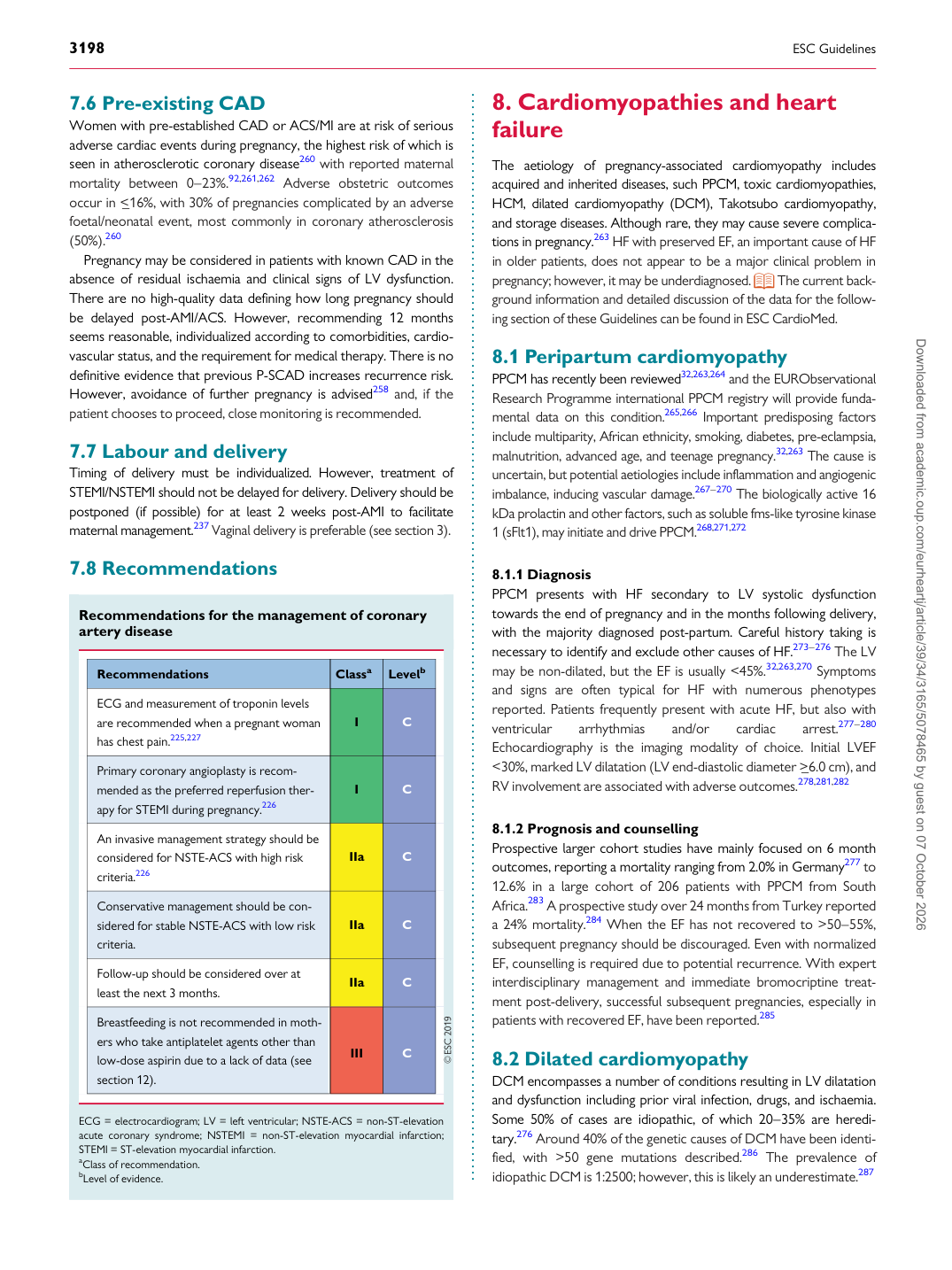
Recommendations for the management of coronary artery disease

Recommendations Classa Levelb

ECG and measurement of troponin levels are recommended when a pregnant woman has chest pain.225,227 I C

Primary coronary angioplasty is recommended as the preferred reperfusion therapy for STEMI during pregnancy.226 I C

An invasive management strategy should be considered for NSTE-ACS with high risk criteria.226 IIa C

Conservative management should be considered for stable NSTE-ACS with low risk criteria. IIa C

Follow-up should be considered over at least the next 3 months. IIa C

Breastfeeding is not recommended in mothers who take antiplatelet agents other than low-dose aspirin due to a lack of data (see section 12). III C

ECG = electrocardiogram; LV = left ventricular; NSTE-ACS = non-ST-elevation acute coronary syndrome; NSTEMI = non-ST-elevation myocardial infarction; STEMI = ST-elevation myocardial infarction. aClass of recommendation. bLevel of evidence. Downloaded from academic.oup.com/eurheartj/article/39/34/3165/5078465 by guest on 07 October 2026