p.32 抽出テキスト
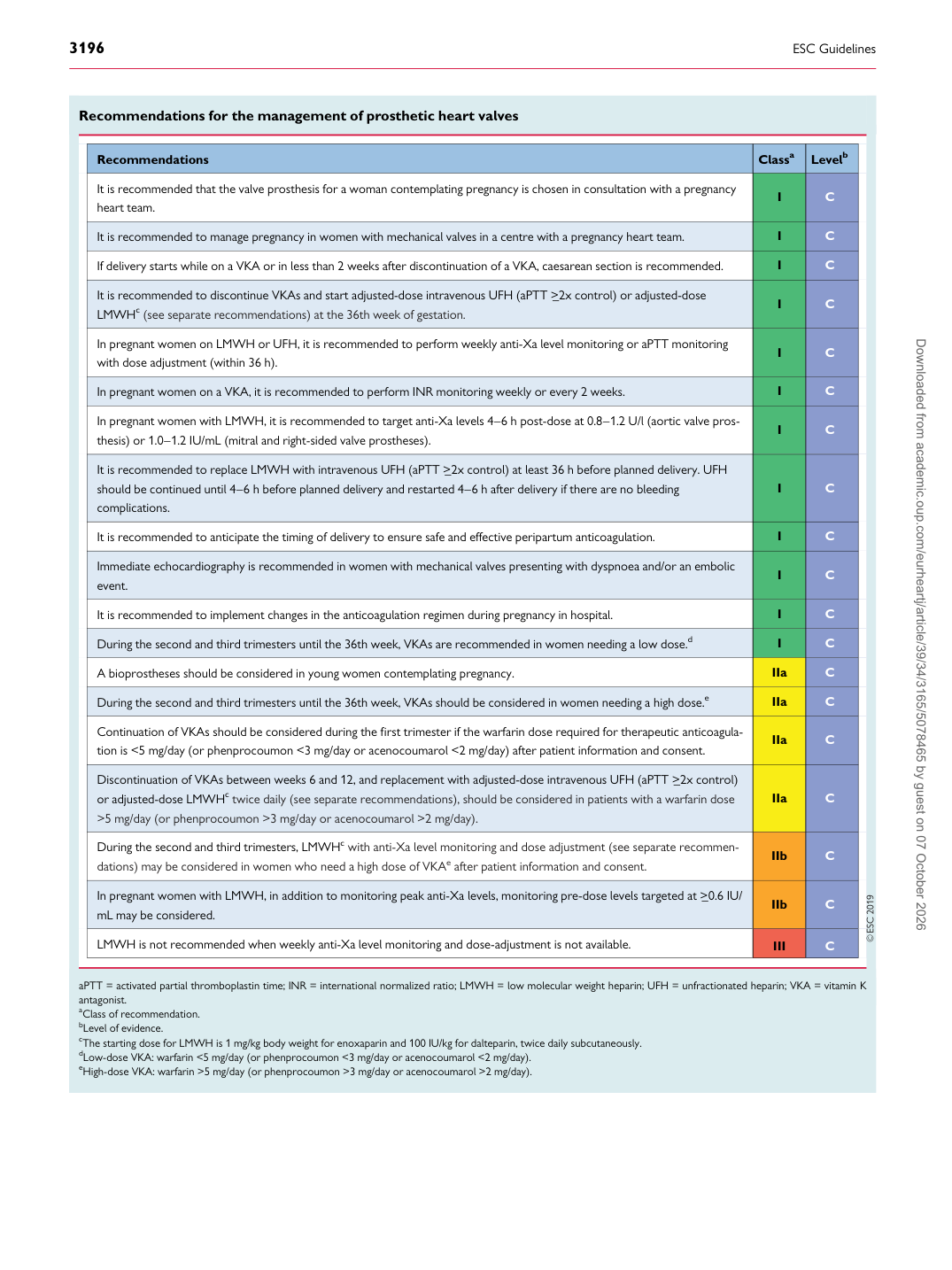
Recommendations for the management of prosthetic heart valves

Recommendations Classa Levelb

It is recommended that the valve prosthesis for a woman contemplating pregnancy is chosen in consultation with a pregnancy heart team. I C

It is recommended to manage pregnancy in women with mechanical valves in a centre with a pregnancy heart team. I C

If delivery starts while on a VKA or in less than 2 weeks after discontinuation of a VKA, caesarean section is recommended. I C

It is recommended to discontinue VKAs and start adjusted-dose intravenous UFH (aPTT >_2x control) or adjusted-dose LMWHc (see separate recommendations) at the 36th week of gestation. I C

In pregnant women on LMWH or UFH, it is recommended to perform weekly anti-Xa level monitoring or aPTT monitoring with dose adjustment (within 36 h). I C

In pregnant women on a VKA, it is recommended to perform INR monitoring weekly or every 2 weeks. I C

In pregnant women with LMWH, it is recommended to target anti-Xa levels 4–6 h post-dose at 0.8–1.2 U/l (aortic valve prosthesis) or 1.0–1.2 IU/mL (mitral and right-sided valve prostheses). I C

It is recommended to replace LMWH with intravenous UFH (aPTT >_2x control) at least 36 h before planned delivery. UFH should be continued until 4–6 h before planned delivery and restarted 4–6 h after delivery if there are no bleeding complications. I C

It is recommended to anticipate the timing of delivery to ensure safe and effective peripartum anticoagulation. I C

Immediate echocardiography is recommended in women with mechanical valves presenting with dyspnoea and/or an embolic event. I C

It is recommended to implement changes in the anticoagulation regimen during pregnancy in hospital. I C During the second and third trimesters until the 36th week, VKAs are recommended in women needing a low dose.d I C

A bioprostheses should be considered in young women contemplating pregnancy. IIa C During the second and third trimesters until the 36th week, VKAs should be considered in women needing a high dose.e IIa C

Continuation of VKAs should be considered during the first trimester if the warfarin dose required for therapeutic anticoagulation is <5 mg/day (or phenprocoumon <3 mg/day or acenocoumarol <2 mg/day) after patient information and consent. IIa C

Discontinuation of VKAs between weeks 6 and 12, and replacement with adjusted-dose intravenous UFH (aPTT >_2x control) or adjusted-dose LMWHc twice daily (see separate recommendations), should be considered in patients with a warfarin dose >5 mg/day (or phenprocoumon >3 mg/day or acenocoumarol >2 mg/day). IIa C During the second and third trimesters, LMWHc with anti-Xa level monitoring and dose adjustment (see separate recommendations) may be considered in women who need a high dose of VKAe after patient information and consent. IIb C

In pregnant women with LMWH, in addition to monitoring peak anti-Xa levels, monitoring pre-dose levels targeted at >_0.6 IU/ mL may be considered. IIb C

LMWH is not recommended when weekly anti-Xa level monitoring and dose-adjustment is not available. III C

aPTT = activated partial thromboplastin time; INR = international normalized ratio; LMWH = low molecular weight heparin; UFH = unfractionated heparin; VKA = vitamin K antagonist. aClass of recommendation. bLevel of evidence. cThe starting dose for LMWH is 1 mg/kg body weight for enoxaparin and 100 IU/kg for dalteparin, twice daily subcutaneously. dLow-dose VKA: warfarin <5 mg/day (or phenprocoumon <3 mg/day or acenocoumarol <2 mg/day). eHigh-dose VKA: warfarin >5 mg/day (or phenprocoumon >3 mg/day or acenocoumarol >2 mg/day). Downloaded from academic.oup.com/eurheartj/article/39/34/3165/5078465 by guest on 07 October 2026