p.29 抽出テキスト
............................................................. thrombosis but is associated with significantly more maternal bleeding complications, including fatal events.196,219,222

6.5.3 Management Pre-pregnancy evaluation should include the assessment of symptoms and echocardiographic evaluation of ventricular function, as well as prosthetic and native valve function. The type and position of valve(s), as well as the history of valve thrombosis, should be taken into account. The option to avoid pregnancy should be discussed with the mother.

6.5.3.1 Medical therapy The advantages and disadvantages of different anticoagulation regimen should be discussed extensively before pregnancy. The mother must understand that the use of VKAs is the most effective regimen to prevent valve thrombosis, and therefore the safest regimen for her, and that risks to the mother also jeopardize the baby. However, the increased risks of embryopathy, foetopathy, foetal loss, and foetal haemorrhage associated with the use of VKAs need to be discussed while considering the VKA dose. The higher risk of valve thrombosis and lower foetal risks associated with LMWH should be discussed. Compliance with prior anticoagulant therapy should be considered. The mother should understand that whatever anticoagulation regime is chosen, her strict compliance is crucial for a successful outcome of the pregnancy.

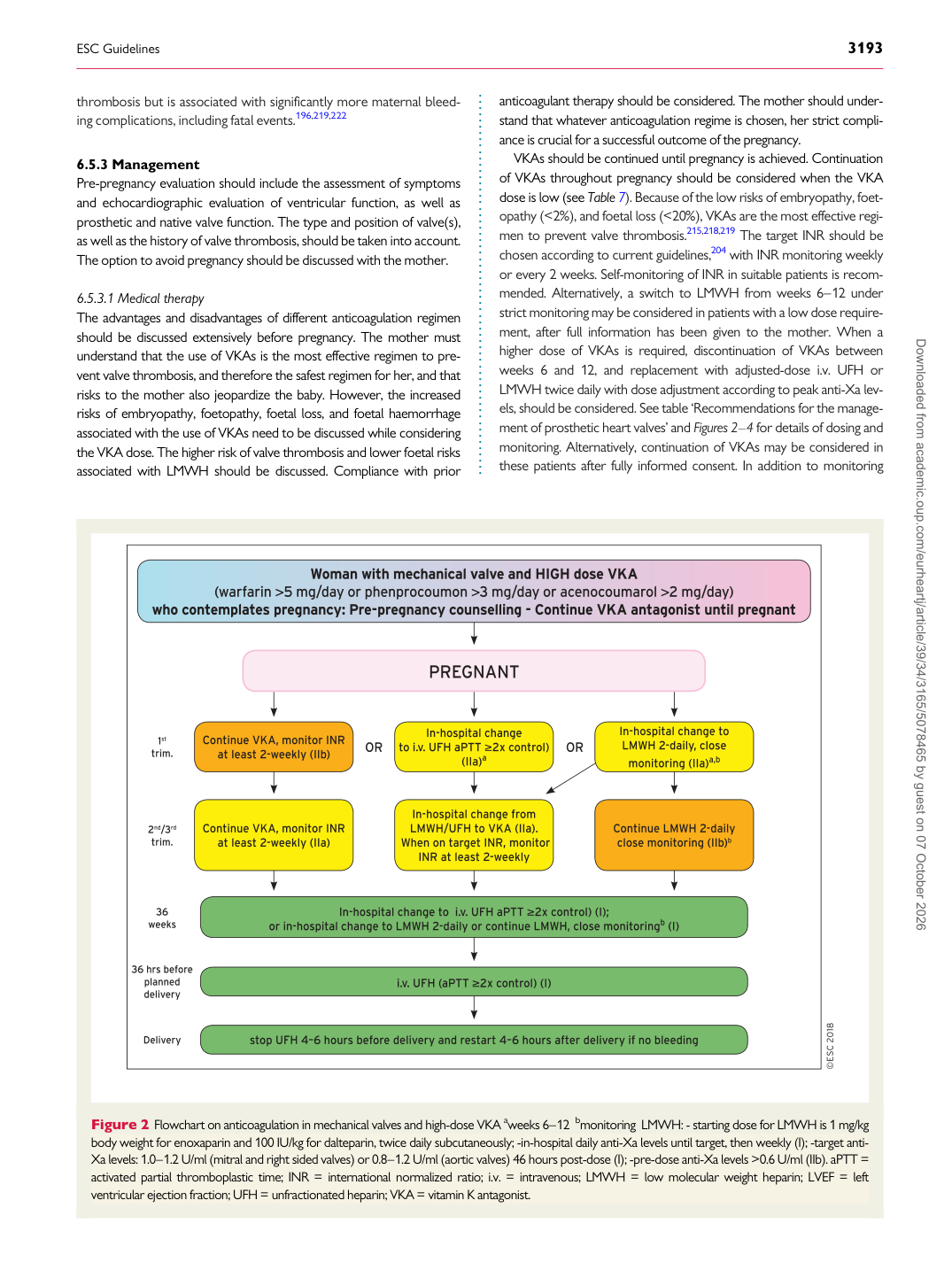
VKAs should be continued until pregnancy is achieved. Continuation of VKAs throughout pregnancy should be considered when the VKA dose is low (see Table 7). Because of the low risks of embryopathy, foetopathy (<2%), and foetal loss (<20%), VKAs are the most effective regimen to prevent valve thrombosis.215,218,219 The target INR should be chosen according to current guidelines,204 with INR monitoring weekly or every 2 weeks. Self-monitoring of INR in suitable patients is recommended. Alternatively, a switch to LMWH from weeks 6–12 under strict monitoring may be considered in patients with a low dose requirement, after full information has been given to the mother. When a higher dose of VKAs is required, discontinuation of VKAs between weeks 6 and 12, and replacement with adjusted-dose i.v. UFH or LMWH twice daily with dose adjustment according to peak anti-Xa levels, should be considered. See table ‘Recommendations for the management of prosthetic heart valves’ and Figures 2–4 for details of dosing and monitoring. Alternatively, continuation of VKAs may be considered in these patients after fully informed consent. In addition to monitoring

Figure 2 Flowchart on anticoagulation in mechanical valves and high-dose VKA aweeks 6–12 bmonitoring LMWH: - starting dose for LMWH is 1 mg/kg body weight for enoxaparin and 100 IU/kg for dalteparin, twice daily subcutaneously; -in-hospital daily anti-Xa levels until target, then weekly (I); -target anti- Xa levels: 1.0–1.2 U/ml (mitral and right sided valves) or 0.8–1.2 U/ml (aortic valves) 46 hours post-dose (I); -pre-dose anti-Xa levels >0.6 U/ml (IIb). aPTT = activated partial thromboplastic time; INR = international normalized ratio; i.v. = intravenous; LMWH = low molecular weight heparin; LVEF = left ventricular ejection fraction; UFH = unfractionated heparin; VKA = vitamin K antagonist. Downloaded from academic.oup.com/eurheartj/article/39/34/3165/5078465 by guest on 07 October 2026