p.22 抽出テキスト
....................................................................

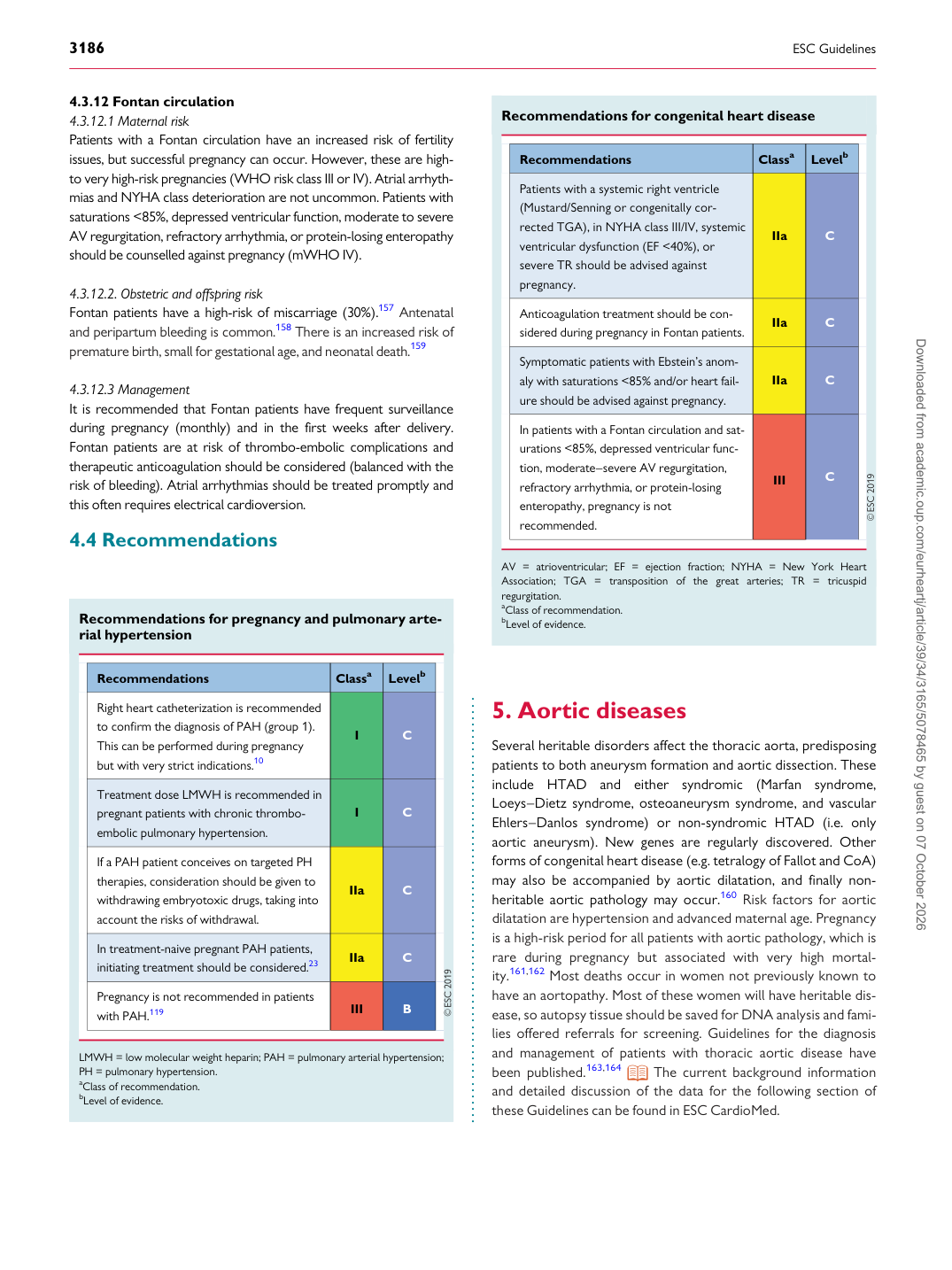
4.3.12 Fontan circulation 4.3.12.1 Maternal risk Patients with a Fontan circulation have an increased risk of fertility issues, but successful pregnancy can occur. However, these are highto very high-risk pregnancies (WHO risk class III or IV). Atrial arrhythmias and NYHA class deterioration are not uncommon. Patients with saturations <85%, depressed ventricular function, moderate to severe AV regurgitation, refractory arrhythmia, or protein-losing enteropathy should be counselled against pregnancy (mWHO IV).

4.3.12.2. Obstetric and offspring risk Fontan patients have a high-risk of miscarriage (30%).157 Antenatal and peripartum bleeding is common.158 There is an increased risk of premature birth, small for gestational age, and neonatal death.159

4.3.12.3 Management It is recommended that Fontan patients have frequent surveillance during pregnancy (monthly) and in the first weeks after delivery. Fontan patients are at risk of thrombo-embolic complications and therapeutic anticoagulation should be considered (balanced with the risk of bleeding). Atrial arrhythmias should be treated promptly and this often requires electrical cardioversion.

4.4 Recommendations

5 Aortic diseases

Several heritable disorders affect the thoracic aorta, predisposing patients to both aneurysm formation and aortic dissection. These include HTAD and either syndromic (Marfan syndrome, Loeys–Dietz syndrome, osteoaneurysm syndrome, and vascular Ehlers–Danlos syndrome) or non-syndromic HTAD (i.e. only aortic aneurysm). New genes are regularly discovered. Other forms of congenital heart disease (e.g. tetralogy of Fallot and CoA) may also be accompanied by aortic dilatation, and finally nonheritable aortic pathology may occur.160 Risk factors for aortic dilatation are hypertension and advanced maternal age. Pregnancy is a high-risk period for all patients with aortic pathology, which is rare during pregnancy but associated with very high mortality.161,162 Most deaths occur in women not previously known to have an aortopathy. Most of these women will have heritable disease, so autopsy tissue should be saved for DNA analysis and families offered referrals for screening. Guidelines for the diagnosis and management of patients with thoracic aortic disease have been published.163,164 The current background information and detailed discussion of the data for the following section of these Guidelines can be found in ESC CardioMed.

Recommendations for congenital heart disease

Recommendations Classa Levelb

Patients with a systemic right ventricle (Mustard/Senning or congenitally corrected TGA), in NYHA class III/IV, systemic ventricular dysfunction (EF <40%), or severe TR should be advised against pregnancy. IIa C

Anticoagulation treatment should be considered during pregnancy in Fontan patients. IIa C

Symptomatic patients with Ebstein’s anomaly with saturations <85% and/or heart failure should be advised against pregnancy. IIa C

In patients with a Fontan circulation and saturations <85%, depressed ventricular function, moderate–severe AV regurgitation, refractory arrhythmia, or protein-losing enteropathy, pregnancy is not recommended. III C

AV = atrioventricular; EF = ejection fraction; NYHA = New York Heart Association; TGA = transposition of the great arteries; TR = tricuspid regurgitation. aClass of recommendation. bLevel of evidence. Recommendations for pregnancy and pulmonary arterial hypertension

Recommendations Classa Levelb

Right heart catheterization is recommended to confirm the diagnosis of PAH (group 1). This can be performed during pregnancy but with very strict indications.10 I C

Treatment dose LMWH is recommended in pregnant patients with chronic thromboembolic pulmonary hypertension. I C

If a PAH patient conceives on targeted PH therapies, consideration should be given to withdrawing embryotoxic drugs, taking into account the risks of withdrawal. IIa C

In treatment-naive pregnant PAH patients, initiating treatment should be considered.23 IIa C

Pregnancy is not recommended in patients with PAH.119 III B

LMWH = low molecular weight heparin; PAH = pulmonary arterial hypertension; PH = pulmonary hypertension. aClass of recommendation. bLevel of evidence. Downloaded from academic.oup.com/eurheartj/article/39/34/3165/5078465 by guest on 07 October 2026