p.18 抽出テキスト
.....................

3.11 Recommendations

4 Congenital heart disease and

pulmonary hypertension

4.1 Introduction

Congenital heart disease is present in 0.8–0.9% of live births.63,136 Lesions vary in severity, but even patients with complex lesions now survive to childbearing years.137 In large international surveys of pregnancy and heart disease, two-thirds of cases have congenital heart disease and 5% have PH.92,138 However, congenital heart disease and PH are rare causes of maternal death.3 The current background information and detailed discussion of the data for the following section of these Guidelines can be found in ESC CardioMed.

In most women with congenital heart disease, pregnancy is well tolerated. The risk of pregnancy depends on the underlying heart

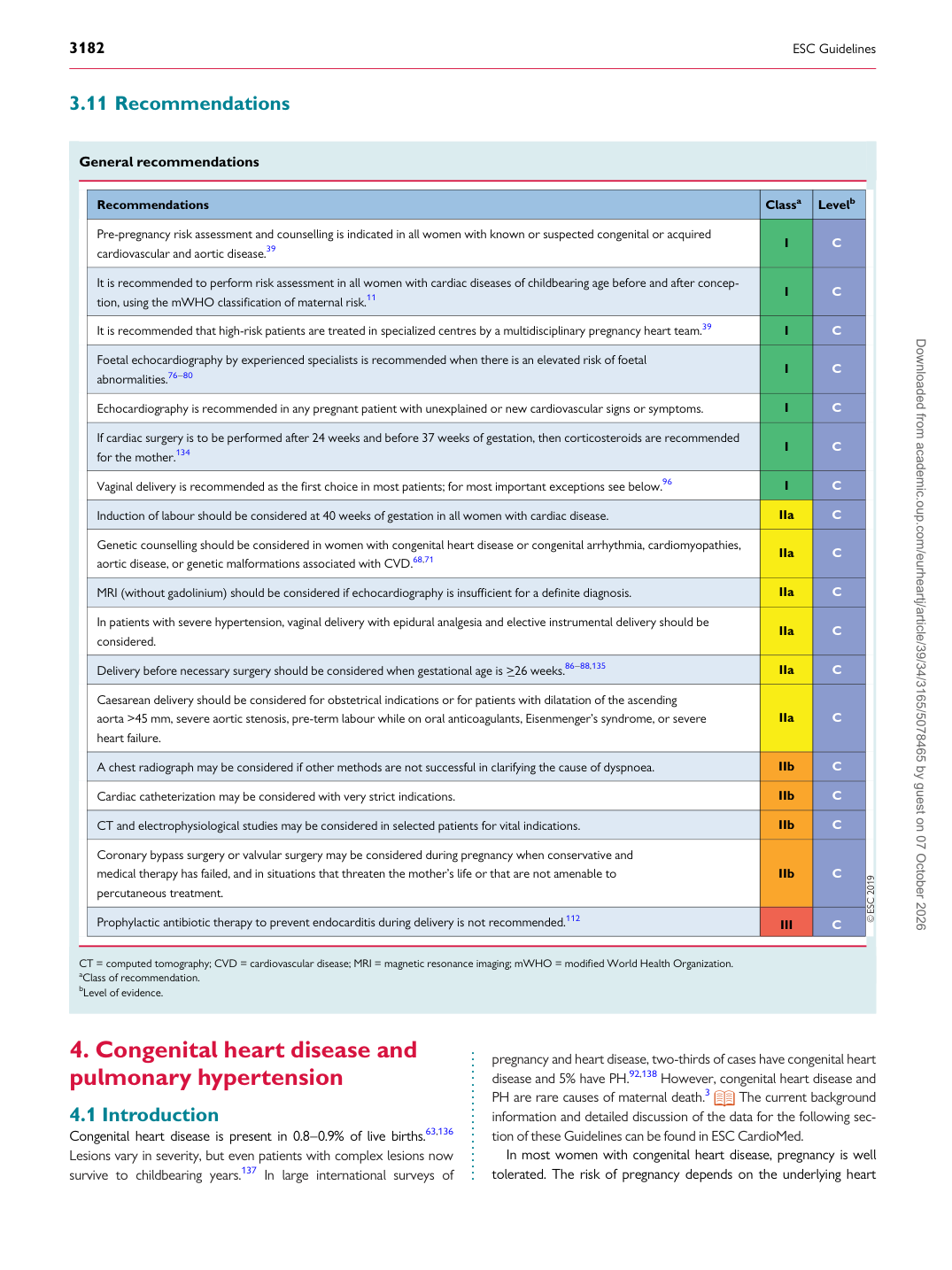
General recommendations

Recommendations Classa Levelb

Pre-pregnancy risk assessment and counselling is indicated in all women with known or suspected congenital or acquired cardiovascular and aortic disease.39 I C

It is recommended to perform risk assessment in all women with cardiac diseases of childbearing age before and after conception, using the mWHO classification of maternal risk.11 I C It is recommended that high-risk patients are treated in specialized centres by a multidisciplinary pregnancy heart team.39 I C

Foetal echocardiography by experienced specialists is recommended when there is an elevated risk of foetal abnormalities.76–80 I C

Echocardiography is recommended in any pregnant patient with unexplained or new cardiovascular signs or symptoms. I C

If cardiac surgery is to be performed after 24 weeks and before 37 weeks of gestation, then corticosteroids are recommended for the mother.134 I C Vaginal delivery is recommended as the first choice in most patients; for most important exceptions see below.96 I C

Induction of labour should be considered at 40 weeks of gestation in all women with cardiac disease. IIa C

Genetic counselling should be considered in women with congenital heart disease or congenital arrhythmia, cardiomyopathies, aortic disease, or genetic malformations associated with CVD.68,71 IIa C

MRI (without gadolinium) should be considered if echocardiography is insufficient for a definite diagnosis. IIa C

In patients with severe hypertension, vaginal delivery with epidural analgesia and elective instrumental delivery should be considered. IIa C Delivery before necessary surgery should be considered when gestational age is >_26 weeks.86–88,135 IIa C

Caesarean delivery should be considered for obstetrical indications or for patients with dilatation of the ascending aorta >45 mm, severe aortic stenosis, pre-term labour while on oral anticoagulants, Eisenmenger’s syndrome, or severe heart failure. IIa C

A chest radiograph may be considered if other methods are not successful in clarifying the cause of dyspnoea. IIb C

Cardiac catheterization may be considered with very strict indications. IIb C

CT and electrophysiological studies may be considered in selected patients for vital indications. IIb C

Coronary bypass surgery or valvular surgery may be considered during pregnancy when conservative and medical therapy has failed, and in situations that threaten the mother’s life or that are not amenable to percutaneous treatment. IIb C Prophylactic antibiotic therapy to prevent endocarditis during delivery is not recommended.112 III C

CT = computed tomography; CVD = cardiovascular disease; MRI = magnetic resonance imaging; mWHO = modified World Health Organization. aClass of recommendation. bLevel of evidence. Downloaded from academic.oup.com/eurheartj/article/39/34/3165/5078465 by guest on 07 October 2026