p.29 抽出テキスト
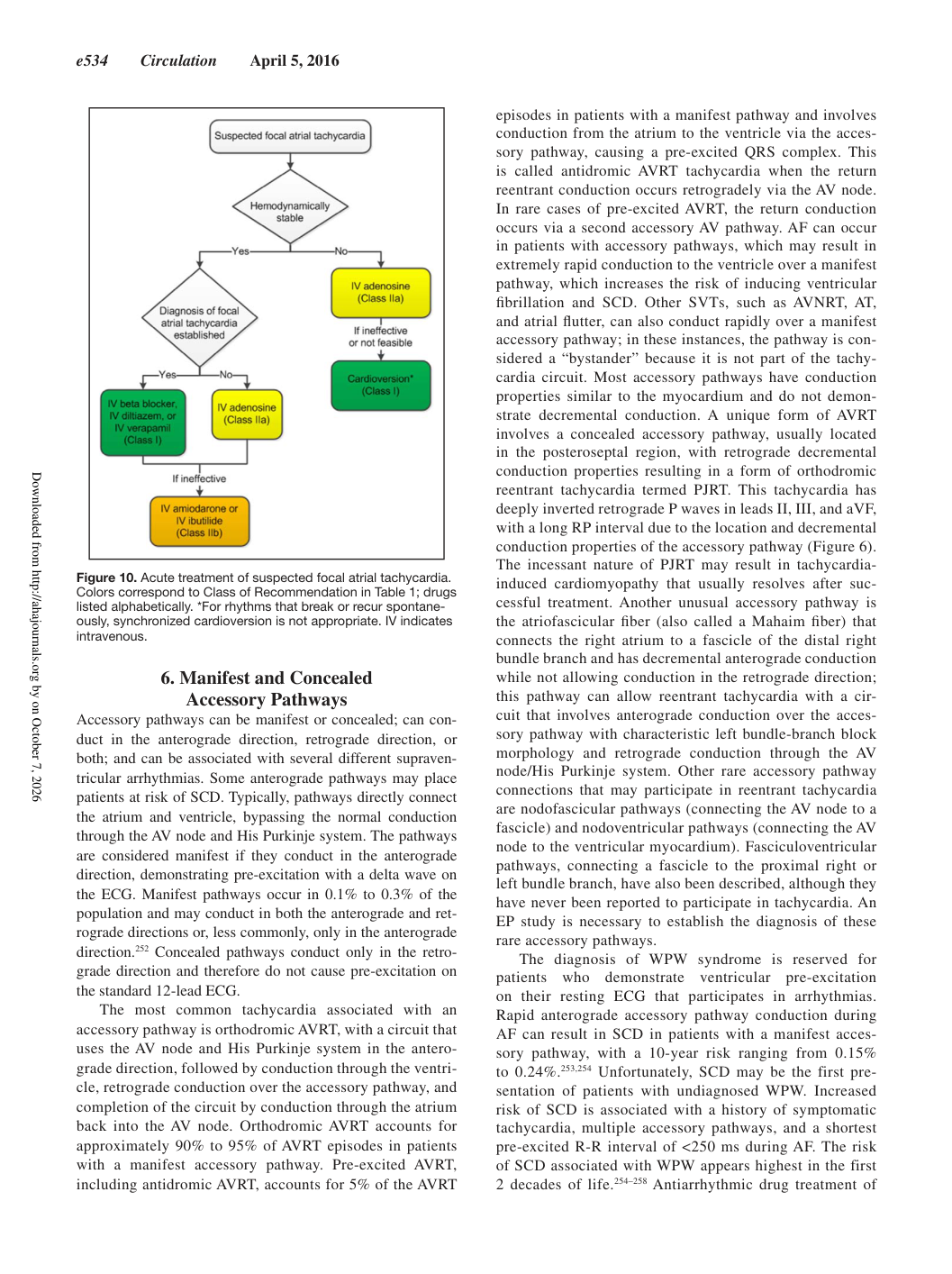
Figure 10. Acute treatment of suspected focal atrial tachycardia. Colors correspond to Class of Recommendation in Table 1; drugs listed alphabetically. *For rhythms that break or recur spontaneously, synchronized cardioversion is not appropriate. IV indicates intravenous.

6 Manifest and Concealed

Accessory Pathways Accessory pathways can be manifest or concealed; can conduct in the anterograde direction, retrograde direction, or both; and can be associated with several different supraventricular arrhythmias. Some anterograde pathways may place patients at risk of SCD. Typically, pathways directly connect the atrium and ventricle, bypassing the normal conduction through the AV node and His Purkinje system. The pathways are considered manifest if they conduct in the anterograde direction, demonstrating pre-excitation with a delta wave on the ECG. Manifest pathways occur in 0.1% to 0.3% of the population and may conduct in both the anterograde and retrograde directions or, less commonly, only in the anterograde direction.252 Concealed pathways conduct only in the retrograde direction and therefore do not cause pre-excitation on the standard 12-lead ECG. The most common tachycardia associated with an accessory pathway is orthodromic AVRT, with a circuit that uses the AV node and His Purkinje system in the anterograde direction, followed by conduction through the ventricle, retrograde conduction over the accessory pathway, and completion of the circuit by conduction through the atrium back into the AV node. Orthodromic AVRT accounts for approximately 90% to 95% of AVRT episodes in patients with a manifest accessory pathway. Pre-excited AVRT, including antidromic AVRT, accounts for 5% of the AVRT episodes in patients with a manifest pathway and involves conduction from the atrium to the ventricle via the accessory pathway, causing a pre-excited QRS complex. This is called antidromic AVRT tachycardia when the return reentrant conduction occurs retrogradely via the AV node. In rare cases of pre-excited AVRT, the return conduction occurs via a second accessory AV pathway. AF can occur in patients with accessory pathways, which may result in extremely rapid conduction to the ventricle over a manifest pathway, which increases the risk of inducing ventricular fibrillation and SCD. Other SVTs, such as AVNRT, AT, and atrial flutter, can also conduct rapidly over a manifest accessory pathway; in these instances, the pathway is considered a “bystander” because it is not part of the tachycardia circuit. Most accessory pathways have conduction properties similar to the myocardium and do not demonstrate decremental conduction. A unique form of AVRT involves a concealed accessory pathway, usually located in the posteroseptal region, with retrograde decremental conduction properties resulting in a form of orthodromic reentrant tachycardia termed PJRT. This tachycardia has deeply inverted retrograde P waves in leads II, III, and aVF, with a long RP interval due to the location and decremental conduction properties of the accessory pathway (Figure 6). The incessant nature of PJRT may result in tachycardiainduced cardiomyopathy that usually resolves after successful treatment. Another unusual accessory pathway is the atriofascicular fiber (also called a Mahaim fiber) that connects the right atrium to a fascicle of the distal right bundle branch and has decremental anterograde conduction while not allowing conduction in the retrograde direction; this pathway can allow reentrant tachycardia with a circuit that involves anterograde conduction over the accessory pathway with characteristic left bundle-branch block morphology and retrograde conduction through the AV node/His Purkinje system. Other rare accessory pathway connections that may participate in reentrant tachycardia are nodofascicular pathways (connecting the AV node to a fascicle) and nodoventricular pathways (connecting the AV node to the ventricular myocardium). Fasciculoventricular pathways, connecting a fascicle to the proximal right or left bundle branch, have also been described, although they have never been reported to participate in tachycardia. An EP study is necessary to establish the diagnosis of these rare accessory pathways.

The diagnosis of WPW syndrome is reserved for patients who demonstrate ventricular pre-excitation on their resting ECG that participates in arrhythmias. Rapid anterograde accessory pathway conduction during AF can result in SCD in patients with a manifest accessory pathway, with a 10-year risk ranging from 0.15% to 0.24%.253,254 Unfortunately, SCD may be the first presentation of patients with undiagnosed WPW. Increased risk of SCD is associated with a history of symptomatic tachycardia, multiple accessory pathways, and a shortest pre-excited R-R interval of <250 ms during AF. The risk of SCD associated with WPW appears highest in the first 2 decades of life.254–258 Antiarrhythmic drug treatment of

Downloaded from http://ahajournals.org by on October 7, 2026